***
war and social upheaval: decisive ancient battles
The Decissive Battles of History: Ancient Battles
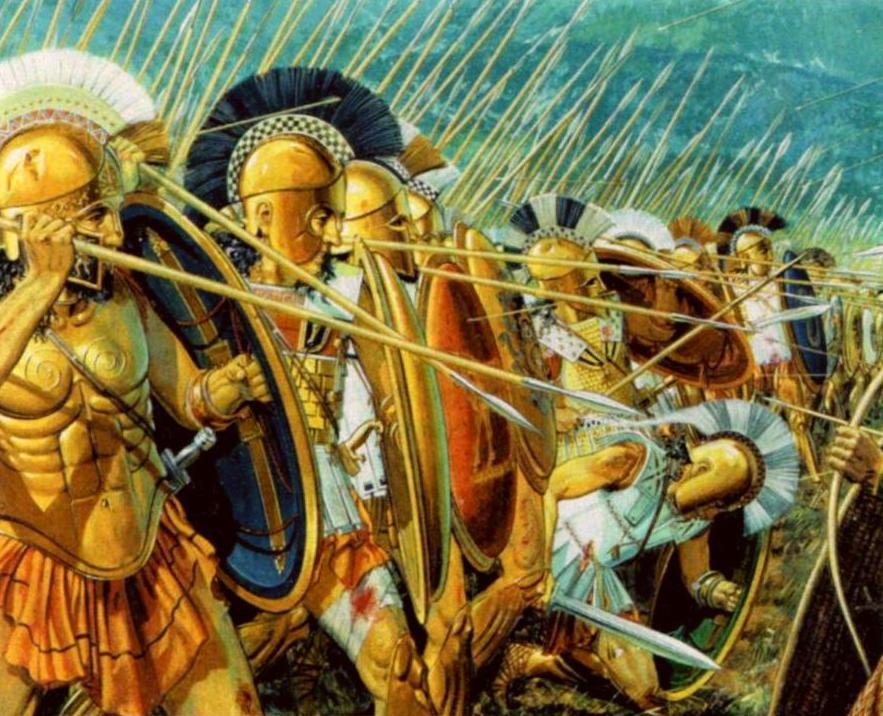
Figure 1.--We know very little about most of the battles fought in the ancient world. The exception to this is the battles of the clasical world, the battles fought by the Greeks and Roman armies. We have quite detailed accounts for many of the important battles. Especially important is Marathon (490 BC) where the Greeks did nothing short of inventing freedom. For two centuries the Greek phalanx would dominate ancient battlefields and creating an empire streaching east from Greece to the borders of India.
Many great battles were fought in the ancient world. Some are lost to history. Others are known, but details are lacking. In most cases the information comes from the victors, thus our information is often biased. Ancient accounts site huge numbers of combatants. These may have been used primarily for literary affect. While these battles occurred in some cases over two millennia ago, they had a powerful impact on shaping our modern world. We have information about some of these battles about these battles as a result of a variety of sources. The first battle we know recorded in any detail by history is Megiddo (1479 BC), although information is still sparse. The first battle for which relatively detailed information exists is Qadesh (1274). Quite a bit of information is available on the battles of the Greek and Roman era. We assume that information on Chinese battles is available, but here we are not yet familiar with the literature. The relative isolation of China is notable, although China did influence developments in Central Asia which would affect the West. The trajectory of these battles with a complicated up and down pattern laid the foundation for the future rise of the west, although we end the ancient era with the fall of Rome. Two areas remained outside the general thrust of history. The Indian subcontinent was only tangentially tied into world history and Native Americans in the New World completely isolated.
Early Violent Ecounters
Violence and conflict are surely as old as the human species. The conflicts of the Neolithic era had to be rather small scale engagements and are by definition unrecorded. This has been seen in modern stone age peoples like on New Guinea. Small hunter-gather bands did not have the capacity to build armies and wage major battles. Nor is there likely to be any archeological evidence. One group of archeologists claim to have found the earliest evidence of a battle, in this case near the Nile on the Egyptian-Sudanese border--Jebel Sahaba. (14,000 BP). 【Wendorf】 Other archeologists dispute the findings that there was an actual battle. 【Crevecour, et. al.】 No one can seriously doubt that there were acts of violence between groups during the Neolithic Era. The question is to what extent such conflict involved what could remotely be called an army and fight a battle. Only with the development agriculture and civilization
was this possible. Archeological work provides us some evidence of early wars and battles., but the archeological evidence is usually subject to various interpretations as at Jabel Sahaba. Unfortunately, only with the development of writing do we have historical evidence giving us undisputed evidence of actual battles. The first battles we know of thus come from Sumerian Mesopotamia, although early Sumerian cities like Uruk were not walled, suggesting a low level of violence. We can not have actual details of battles until writing was developed. The earliest writing appeared in ancient Sumer (Mesopotamia) (around 3100 BC). It is notable, however, that despite the discovery of countless clay tablets, there is no mention of war in ancient Summer for centuries. Quite a number of early battles are known to history, but we know virtually nothing about them. Few details about the battle exist other than the victor and vanquished and in some cases the date. Normally we only get the victor's view.
The Neolithic Revolution (c10,000 BC)
The Neolithic or Agricultural Revolution was the point at which human society began to evolve from the small, isolated nomadic hunter-gatherer bands of the Stone Age to larger, settled communities inventing agriculture -- essentially the birth of civilization. This first occurred in the the Fertile Crescent of Mesopotamia. It was here the mankind first began to farm in a major way. Other Stone Age humans in various parts of the world, especially river valleys, subsequently on various time scales also began this transition. As cities began to grow so did civilization. The two are intrinsically linked. It is at this point we first see major battles and warfare. Certainly violent encounters occured during the stone age. The stone tools man developed during the Neolithic period have an obvious dual usage--they can also be used in violent encounters against other humans. But the Neolithic Revolution made land more valuable--something that was not only worth defending, but also seizing. It also entailed a developing level of organization that was capable of activities like irrigation and monumental architecture and also creating armies and waging wars -- including great battles that would shape the course of history.
While we have no evidence of battles before Tell Hamoukar, there is plenty of evidence that battles were being fought because of the discovery of weaponry. A particularly interesting archeological find has occurred in modern Israel--the discovery of the mass production of weapons. 【Israel Antiquities Authority (IAA)】 This is sure evidence that battles were being fought. There is evidence that a factory existed to produce standardized weapons. This mean the highly organized activity to arm warriors in preparation for battle. Hundreds of stone projectiles were discovered from two archeological sites En Esur and En Zippori). What was being produced was sling stones. They were being produced to precise specifications (averaging 52 mm long and 31 mm wide and weighing 60 grams) leading to stones with a biconical form, the best aerodynamic characteristics for slinging. This was occurring in the early Copper Age.
Tell Hamoukar (c3500 BC)
The first evidence of warfare and a battle comes from Tell Hamoukar in modern extreme northeastern Syria. It was part of the Sumerian agricultural and trading civilization. Excavation work undertaken before Syria became a deadly modern battlefield (2005-06) discovered that the city was destroyed by an invading force (around 3500 BC). This is the earliest evidence we have of an ancient battle. Of course once writing was developed, we begin to get actual accounts of battles. As it was before the invention of writing, there are no written account. We know a battle occurred because of the destruction of the city and the presence of thousands of clay balls, ammunition for slings. 【[Wilford】 It was first thought this was an invasion of Uruk forces. Uruk was the great metropolis of the era. Hamoukar was within the Uruk trading area, and perhaps founded as an Uruk colony. Uruk was, however, more of an economic than a military power. And the evidence is stronger that Hamoukar was attacked by pastoral nomads than by an Uruk army. This seems to be the beginning of the conflict between agriculturalists and pastoral nomads that would be a major factor in both ancient and medieval history.
Sumer and Elam (2700 BC)
The first war for which there is a written record took place in southern Mesopotamia, the region between the two graet rivers--the Tygris and Eupphrates, between Sumer and Elam (2700 BC). Sumer in southrn Meopotamia is commonly viewed as the first collection of city states--the beginning of civilization. Sumerian farmers suceeded in developing modern grains and growing an agricultural syrplus. This surplus enabled them to settle in one place and essentially invent civilization. They also devloped proto-writing (before 3000 BC). This is important be\v\cause there is fragmentary written evidence. It seems almost impossible that there were not earlier military action, only there was no writing to record it. Elam was not far behind Sumer. It was an pre-Iranian civilization located east of Mesopotamia, in the southwest of modern-day Iran. The name Elam derives basically from a Sumerian transliteration. Elamite states were among the leading political forces of the early ancient Middle East. Elam was also known as Susiana because of its capital Susa. This appears to be more of a battle than a war. We are not sure about the cause, but surely it was mix of land, water, and raiding. Sumer and Elam probably had been fighting for a long time before the actual battle. The Sumerians, commanded by the King of Kish, Enembaragesi, defeated the Elamites and 'carried away as spoils the weapons of Elam'. Elam was not destroyed and battles between Sumer/Babtlonia and Elam followed. It was esentially the beginning of conflict which we now see between the Arabs and Iranians.
Standard of Ur (c2550 BC)
The Standard of Ur is an one of the most famous artifacts from ancient Sumer. It is a hollow wooden box inlaid with a mosaic of shell, red limestone and lapis lazuli. It comes from the ancient city of Ur (in modern Iraq). The inlays depict war and peace in Sumer. It is thus clear that at the time there was fighting and war, alhough there are no details about specific battles and wars. The decoration, however, provides insights on uniforms, weaponry, and a kind of early chariot--more of a war waggon.
The next evidence of a an early battle again comes from Sumer. This gives a misleading impression, that ancinct Sumer was a warlike civilization. Nothing could be further from the truth. Early Sumerian cities did not have walls, a strong indication that warfare was not endemic. And Sumerian civilization developed a millennia before we see wars and battles between Sumerian city states. Inevitably, however, as Sumer developed and city states grew, conflicts developed over the agricultural land between them. Uruk was the main city and there is no evidence of a militarized society. The earliest account of a war and battles comes from Lagash (c2450 BC). Lagash and the neighboring city of Umma quarreled over land located between them. The conflict is described in the Stela of the Vultures. King Eannatum of Lagash, inspired by Ningirsu, the patron god of his city, marched out with his army to attack neighboring Umma. Precise details about the ensuing battle do not exist. The Stela does portray a few details. The carved depiction suggest that when the two armies met, King Eannatum climbed down from his chariot and led his forces on foot. Chariots at the time were more four wheel heavy wagons. The Lagash army lowered their spears and advanced on Umma in a solid phalanx. A short clash ensued and Lagash emerged victorious. King Eannatum was struck in the eye by an arrow, but survived. The battle between the two cities are the the earliest documented battles known to history. The Stela and an Umma tablet provides a written account, however imperfect.
Battle of Ur (c2271 (BC)
We also have evidence of the first great war and the battle of Ur (c2271). This was Sargon's conquest of Sumer. This lead led to the establishment of the Akkadian Empire--if not the world's first empire, the largest Sumerian empire. Sargon began as just another City-state ruler. He proved ti be a very successful military commander and brought many of the Americanism city states under his control.
Some historians point to Megiddo as the first battle recorded in detail by history. Megiddo is one of the most fought over places in the world. It is located in central Palestine on the plain of Esdraelon (Valley of Jezreel). Megiddo'is located on a strategic position commanding the Via Maris, one of the principal trade routes between Egypt, Syria and Mesopotamia. Remains at the site have been dated to 3000 BC. It is likely that battles were fought there before the 1479 battle. The first recorded battle in history involved an invasion by Egyptian Pharaoh Thutmose III. The Pharaoh marched east against the king of Kadesh in Palestine who had organized a revolt against Egypt. This Canaanite coalition had received aid from the Mitanni Empire which was developing vassal city-states encroaching upon areas previously controlled by Egypt (15th century BC). The king of Kadesh and his allies took up positions in Megiddo, a strong fortress controlling invasion and trade routes north to Lebanon and east to the Euphrates. Megiddo sat on a height where the road emerged from the narrow Aruna Pass into the wide Plain of Esdraelon.
Tuthmosis less than a year after becoming Pharaoh moved against the Canaanites. He marched from the border fortress of Sileh along the Sinai road called the "Ways of Horus" to Gaza. This was the main Egyptian strong point in Canaan. Along the way he besieged Jaffa leaving forces there under general Djehuty. His slow march suggest that the Canaanite alliance had considerable support even in the south.
Megiddo is also mentioned in the Bible, but centuries later. Babylon was a new empire that arose in western Asia centered on the ancient city with the decline of the Assyrian Empire, The Babylonian Empire gradually expanded and defeated the Assyrians. The Jews under their king Josiah were Assyrian allies. The Egyptians dispatched troops to assist the Babylonians, but Josiah and the Jews at the battle of Megiddo blocked the Egyptian column (609). The Babylonians even without Egyptian assistance defeated the Assyrians . Babylonian became the dominant power in western Asia. It was at Meggido that of Sisera's host were defeated (Jud. 5:20). Here Gideon's 300 chosen men surprised and routed them on the northern plain (Jud. 7). Several other battles recorded in the Bible occurred here. Meggido is better known to Biblical scholars as in the New Testament it is refereed to as Armageddon,. (Saint John took the Hebrew for Mount Megiddo, Har Megiddo.) The book of Revelation prophesies that this will be the location of the last great battle which will be fought by the forces of good and evil. Field Marshall Edmund Allenby in World War II commanded Australian cavalry and Indian infantry up the Aruna Pass to surprise and defeat the Turks occupying the heights of ancient Megiddo.
Qadesh / Kadesh (1274 BC)
Qadesh is a battle of considerable importance because it is the first battle for which historians have a detailed account. It was also a very sizeable battle, as far as we know the greatest battle ever fought up to date and the ultimate chariot battle. The rising Hittite Empire was contesting the New Kingdom's Egyptian dominance and control of trade routes in what is now Syria. The two armies had the most modern weapons of thee day, swords, axes, and composite (wood, horn, sinew) bows. Metallurgists had developed highly effective bronze weapons. The Hittites favored straight swords, the Egyptians curved swords. Chariots were the mainstay of Middle Eastern armies at the time. Wall carvings show chariots being mass produced. Each side had distinctive chariots. The three-man Hittite chariots were stronger, but slower and less maneuverable. The two-men Egyptian chariots were faster and more maneuverable. Both side deployed fleets of chariots. And Qadesh was perhaps the greatest chariot battle of all time.
Pharaoh Ramesses II rose to the throne upon the death of his father Seti I (1279 BC). Ramses was a valiant war commander. He had campaigned as crown prince with his father in Syria. He was determined to be a great pharaoh. Qadesh was a city strategically located along important trade routes on the border between the Hittite Empire and Egypt. Seti had conquered Qadesh, but it was later lost to the Hittites. Ramses was determined to retake the city and amassed an army of four corps, each with about 5,000 men. Ramses made no secret of his plans so the Hittite king, Muwatallish, gathered an even larger army to meet him. Muwatallish had 2,500 chariots and 40,000 infantry. Both armies fought with spears, swords, and bows. The Iron Age had begun, but both armies fought with mostly bronze weapons. Qadesh involved a 1,000 mile march of about a month for the Egyptians. Ramesses II moved north with the lead Amun corps. The other three corps were strung out on the desert behind him. As Ramses neared Qadesh, Bedouins in the service of the Hittites mislead him about the location of the Hittite army. He thus moves forward toward the city without waiting for the rest of his army. It was a terrible mistake. Ramses soon found himself northwest of Qadesh facing the entire Hittite army with only one of his corps. The Hittites were in battle order prepared to attack. Ramses sent messenger to the closest corps--the Re Corps. They rushed forward to join the Pharaoh, but Muwatallish had anticipated this move and attacked with his chariots and decimate the Re corps infantry. The Re corps chariots who were moving ahead of the infantry joined the Pharaoh and warned him that the Hittites were attacking. The Hittite chariots after destroying the Re Corps, turned north and attacked Ramesses' camp. Here accounts vary. Some maintain that the Amun corps infantry panicked and ran. Other sources say that Amun bowmen inflicted heavily casualties. The Hittite attack also appears to have been broken up by the tents and baggage in Ramses camp. They also appear to have been detracted by booty. Ramses although heavily outnumbered decided to use his numerically inferior chariot force to attack. Muwatallish seeing his first attack had failed, committed the rest of his chariot force. Just as the two forces are about to clash. the Ne'arin, the elite troops that had taken the coastal road arrive on the battlefield and caught the Hittites by surprise. Large numbers of Hittite soldiers were killed and their army had to withdraw north of the Orontes River. The huge Hittite infantry force which outnumbered the Egyptians more than two to one was never committed to the battle. With his chariot force largely destoyed, Muwatallish decided to break off combat. The two largely undefeated forced faced each other across the Orontes River, but did not resume combat. Ramses returned to Egypt and declared what seems to have been a stand off a great victory and depictions of that victory were emblazoned on the temples and palaces he had built. Later a peace treaty was negotiated with the Hittites to present a united front against the Assyrians. Surviving stone copies have been found in both Egypt and Turkey. Many historians consider this to be the oldest recorded peace treaty in history. Ramses married two Hittite princes. The reason we know about this battle is that it was described and depicted in great detail in monuments to Ramses, especially his great temple, the Ramsesium, in Luxor. The battle takes on even greater importance when it is considered that if Ramses had lost, the Hittites would have extended their empire south into Syria and Palestine and threatened Egypt itself. This means that the Jews would have come under Hittite influence. Important parts of the Bible concern the relationship between the Jews and Egypt. Given the influence of the Jews on Western civilization and Christianity, this development could have had very significant consequences.
Pelusium (525 BC)
The Battle of Pelusium was the decisive battle between Persia and pharonic Egypt. The battle was fought by Pharaoh Psametik III (Psammenitus) and the Persian Emperor Cambyses II--son of Cyurus the Great. Persia was the conquering superpower of the Middle East. And Egypt was the only power of the region that remained unconquered. A personal matter was also involved. Cambyses was angered that Psammenitus' father, Amasis, had the afrontary of sending him a 'fake' daughter'. His response was to invade Egypt to avenge such an insult. Cambyses had requested that Pharaoh Amasis send his daughter to be a concubine. Egyptian pharaohs did nor normally do this even when the daughter was to be a wife and queen. To be a concubine was unthinkable, however, such was Persia's power that Amasis consented. But to avoid such a disgraceful fate for his daughter, he sent the daughter of the late Pharaoh Apries. The fake daughter, however, was not very pleased with her fate and explained to Cambyses just who she was. Cambyses was not about to accept such a insult and began to plan a war. By the time the preparation to invade Egypt had been completed, Amasis had died and his son Psammenitus was Pharoah. Despite this, the war preparation continued. Psammenitus knew that the Persian Army was coming and fortified a position at Pelusium in the Nile Delta and braced for the Persian assault. Psammenitus had only been Pharaoh for a mere 6 months, but he was confident. He had a substantial force annd a strong, well provisiond fortress capable of beating back a charge or withstanding a siege. And he had important ally--or thought he did.
It might be said that Western civilization was born on the dusty plains of Marathon. Athens had overthrown their brutal tyrant Hippias whose family had attempted to return a monarchy to Athens (510 BC). Hippias fled to Persia. Athens gradually developed a democratic system of government. Athens and Ereteria encouraged the Ionian Greek city states in Anatolia to revolt from the Persian Empire. Perian Emperor Darius the Great suppressed the revolt (494 BC). He pledged to reek his revenge on the Greeks. The first Persian invasion fleet was foiled by a storm (492 BC). Darius sent another massive invasion force of 600 ships and a huge army under Dacious to punish the Athenians and reinstall the deposed tyrant Hippias. It was a foregone conclusion that the massive Persian Empire could easily defeat and humiliate Athens and its allies. The Persians succeed in destroying Eriteria (490 BC) and then moved on to attack Athens. Hippias helped select Marathon as the best place to land. Marathon proved to be the decisive battle of the first Persian War. The Persians landed on the plain of Marathon. It was a broad plain, perfectly suited for deploying a large military force. Athens appealed for Spartan support, but the Spartans in the middle of a religious festival, refused to immediately come to Athen's aid. They arrived a day after the battle was fought. The modern marathon race is named after a run made by an Athenian to request Spartan aid. Even without the vaunted Spartan infantry, the Athenian infantry defeated the immense Persian army. The Athenian commander was Miltiades. Historians know very little about him. His Athenian force augmented with troops from it allies, especially Plataea faced a much larger Persian force. The Greek forced was based on the armored infantrymen--the hoplites. They faced a Persian force twice as large, but much more varied--drawn from all over the vast Persian Empire. The Persians were led by Artaphernes, son of a satrap of Sardis, and Datis, a Median admiral. The Greeks waited on the hills around Marathon, hoping for the Spartans to arrive. The Persians waited 4 days and then seized upon a plan. They divided their force. Datis reembarked the cavalry and some of the infantry to attack undefended Athens by sea. Miltiades decided to seize the opportunity and attack the Persians force remaining at Marathon led by Artaphernes while his force was weakened and without their cavalry. Miltiades extended his battle line by weakening the center, but keeping the flanks strong. The well armored and drilled hoplites smashed the less heavily armored Greeks. As the Greek flanks closed in on the Persians, they finally broke fleeing for their ships. It is at this time that large numbers of Persians were killed. Miltiades then rushed his army back to Athens. When Datis arrived off Athens with his ships, he was suprised to see the Athenian army awaiting him. He decided against invasion and returned to Persia.
Thermopylae / Salamis (480 BC)
Darius vowed revenge for his defeat at Marathon. This was the third campaign of the Persian Wars. Darius planned another massive campaign, but died before the invasion could be launched. It was his son Xerxes who deployed a huge army of about 250,000 men and a naval force to support it. The goal was to conquer all of Greece and add it to the vast Persian Empire. Xerexes' army marched along the coast taking city after city in northern Greece while the fleet kept his army supplied. A force of Greek city states met the Persian army at Thermopylae (480 BC), a pass between Mt. Oeta and swamps along the shore of the Malic Gulf. The made their stand at Thermopylae because it was a mountain pass leading into Greece. Not only was it a key position, it meant that Xerxes could not employ his massive army to full affect. His soldiers were not heavily armored like the Greeks. The were equipped and trained to fight battle of movement on the vast open plains of Asia as it was known then. This time the Spartans were involved. They had been embarrassed by their failure to participate in the battle at Marathon. The small Spartan force of about 300 hoplites under Leonidas delayed a massive Persian Army at Thermopylae. The Greeks inflicted mounting casualties as the Persians charged the Greek phalanxes time after time. Even the Persian Imortals could not break through the heavily armored Greeks. A traitor showed the Persians how to outflank the Greeks. The main Greek army withdrew, but the Spartans stood and were killed to a man. The Persians suffered heavy losses, but given the size of the army not serious. It did affect the morale of the Persian army and gave heart to the Greek city states resisting the Persians. Xerxes was, however, only delayed at Thermopylae. The Persians marched on to Athens. The Athenian commander Themistocles, however, withdrew from the city and Xerxes found an abandoned city. The Persian fleet was destroyed at the decisive battle of Salmis (480 BC). The naval victory was especially important. Without the navy, the huge Persian army could not be supplied. Greece was exceedingly mountainous. War with the Greeks was only practical for the Persians by transporting and supplying its large army by sea. Without the fleet, the Persian Army was cut off from supplies. Xerxes returned to Persia. The Persian Army was left under the command of Mardonius. The next year the Greeks commanded by the Spartan general Pausanias and the Athenian general Aristides destroyed that army at Plataea (479 BC). The Athenian fleet also defeated another Persian naval force at Mycale. Conflict between the Persians and Greeks continued for years, but never on the same scale. The Greeks had maintained their freedom and what followed was one of the greatest cultural flowering in history--essentially the birth of Western civilization.
Plataea (479 BC)
Marathon and Salamis might be called flukes, the result of superior generalship and Greek naval superiority. Surely the huge Persian Empire, the superpower of the day, would eventually overwhelm the tiny Greek city states. This question was answered at Plataea (479 BC). It is here that the Greeks finally won their freedom. And this time there would be no narrow pass or navy to aid the Greeks. The Greek hoplite forces arrayed in phalanxes met the huge Persian army in face to face combat. The Greek victory ended the Persian threat to Greece and thusn was a key event in history. It made possible essentially the birth of Western civilization with the flowering of Greece's Golden Age.
Gaugamela was Alexander's greatest victory. Alexander's brilliance and bravery was posed against a vastly superior Persian army. It is arguably the greatest victory of any military commander in history. It was at Gaugamela that the fate of the vast Persian Empire was decided. Alexander the Great at Gaugamela near Arbela (modern Erbil) decisively defeated the huge army amassed by Persian Emperor Darius III. This was a huge battle involving some 300,000 men. Amazingly the Persians outnumbered Alexander 5 to 1. Alexander's generals upon learning of the size of Darius' army advised him to attack at night least his army be intimidated. Alexander is famously said to have replied, "I will not steal my victory." He antagonized over the tactics for the battle, but once he had settled on his plan, fell into as deep sleep. He had to be awakened in the morning. Darius had carefully chosen the battlefield. He had learned from his previous defeats where the terrain had prevented him from deploying his larger forces to full effect. Gaugamela was a flat plain where his massive army would have space to maneuver. He even prepared the ground for his vaunted chariots. Alexander had also considered the Persian chariots. His Phalanx of spear men opened probing channels and in those channels archers killed the charioteers. Ranks of cavalry and infantry engaged each other in a furious battle. Then Alexander spotted a weak point in the Persian leading straight for Darius. Alexander focused his attack on that one point -- what the Germans would later call the Schwerpunkt. It was the only place on the entire battlefield that Alexander had a numerical advantage. As Alexander began to break through the Persian line, Darius panicked and fled. Persian cavalrymen were about to break Alexander left flank, but a Phalanx held in reserve stopped them. The Persians seeing Darius fleeing fell back and Alexander was able to crush a hugely superior Persian force. There were enormous repercussions. Greek culture spread throughout the Persian Empire, essentially all of the Middle East.
Ipsus (301 BC)
The vast Persian Empire was destroyed by Alexander. After Alexander's death (323 BC), his generals (the Diadochi) divided his empire. Palestine was on a fault line between rival Greek kingdoms. Ptolemy invaded Palestine (320). The Battle of Ipsus fought to the north of Palestine was a major encounter between the Diadochi settling the fate of Alexander's empire (301 BC). Ipsus was a small village in Phrygia. Antigonus I Monophthalmus and his son Demetrius I of Macedon fought a coalition of three other companions of Alexander: Cassander (Macedon), Lysimachus (Thrace), and Seleucus I Nicator (Babylonia and Persia). This was the last effort to unite Alexander's empire. Antigonus had been the only general able to consistently defeat the other Successors. His death meant the end of Alexander's empire. Ptolemy held Egypt, Seleucus receiving the bulk of Antigonus' lands in the east and eastern Asia Minor, and Lysimachus receiving the remainder of Asia Minor. Seleucus would eventually defeat Cassander and Lysimachus (281 BC), but died shortly afterward. This began a period of conflict between the Ptolemic and Seleculid empires
Chinese Unification (260-110 BC)
The Roman and Chinese Empires coalesced at about the same time. Huge battles were fought in the Middle Kingdom during the 3rd and 2nd centuries BC. We do not yet have details on individual battles, nor were they known in the West. These battles are, however, hugely significant because they led to the formation of a unified China under the Han. The Qin and Han emperors succeeded in welding together warring kingdoms into a unified China. Through the twists and turns of Chinese history, one basic principle was held by the Chinese--China was a single unified nation. At the time the West was being unified by the Romans. Ultimately the west with the breakup of the Roman Empire developed as individual nation states, China whole there were revolutions and dynastic changes saw a unified nation as the proper order of affairs into modern times. Many innovations in military technology occurred. After the fall of Rome, China became the great engine for generating technology. It was during the Roman era that contacts developed between China and the west--the development of the fabled Silk Road. Many technologies flowed slowly, but they did flow. The West for nearly two millennia had virtually no impact on China. China had a huge impact on the west. When the Middle Kingdom was strong, the war-like Steppe people were deflected west and tribes like the Huns, Mogols, and Turks pillaged and burned, playing a major role in the collapse of the Roman Empire. It was the Steppe people that drove the Germanic tribes west into the Roman Empire. When the Middle Kingdom was weak, the steppe people attacked south into China. The Chinese technological engine persisted until the West essentially invented science and capitalism (17th-18th centuries). The combination resulted in a technological explosion that Chinese and other traditional societies could not match. China for all its artistic and technological brilliance developed neither science or capitalism, let alone democracy.
Cape Ecnomus (256 BC)
Rome until the First Punic War was a land power. Carthage dominated the seas. But to fight the Catheginians in Sicily they needed a fleet. So with no tradition of naval warfare, they began building a fleet. And they built a fleet virtually from scratch. The Romans sent a fleet of 330 ships to strike at the Carthage. Before completing the crossing of the Mediterranean, it ran into a Carthaginian fleet of 350 ships, near modern Licata, at Cape Ecnomus, an early 3rd century city founded by refugees from Gela.
The resulting battle may have been the largest naval battle in history based on the number of ships and the men involved. Some 300,000 men may have been involved. Of course, historians warn against taking the numbers uncritically. The Romans inflicted a crushing defeat on the Punic fleet
The Roman commander Regulus took every captured Cartheginian ship home to expand Roman naval power. The Cartheginians ost close to 100ships, mostly captured. The Romans suffered very little damage. The Roman victory at Cape Ecnomus enabled them to attack Africa and almost completely defeated the Cartheginians.
Battle of the Aegates (241 BC)
The Battle of the Aegates (Isole Egadi) was fought off the Aegadian Islands, three small islands along the western coast of the Sicily (241 BC). It was the final naval battle fought between the fleets of Carthage and the Roman Republic during the First Punic War. The War had begun in Sicily at a time that Rome was a land power without a significant power and Carthage was the dominant sea power. During the course of the War Rome learned about naval construction and sea warfare. The Roman Republic was bankrupt because of the War. Citizens stepped up to finance construction of a major fleet. Some 500 warships clashed at the Aegates with many more transports involved. And in Aegate the more competent Roman navy commanded by Catulus defeated a large, but poorly trained Punic fleet. It was the most decisive naval battle in history. Nearly half of the Carthaginian fleet was sunk or captured. And as a result of huge losses, the Carthaginians sued for peace. In the Peace of Lutatius, Carthage surrendering Sicily and adjoining islands to Rome. More importantly it left Rome in control of the Mediterranean. (Hannibal during the Second Punic War was forced to attack Rome by crossing the Alps because Rome controlled the sea.) Rome would in fact control the Mediterranean for seven centuries.
Cannae (216 BC)
Carthage and Rome in the 3rd century BC struggle for dominance in the Mediterranean in the epic Punic Wars. Hannibal crossed the Alps and fought battles with small Roman forces. The battle of Cannae was one of the greatest battles fought in the ancient world. Rome decided to amass a huge army to confront Hannibal and defeat Rome once and for all. The two armies met near Apulia in southern Italy. Rome had eight legions, each with more than 5,000 men and a total force of 70,000. Rome had two commanders, Psaulis and Varo. Hannibal had an army composed of men from many different different countries: Libyan spear men, Nubian cavalrymen, Spaniards, and Gauls (Celts). The Romans had a larger army, but Hannibal had an advantage in cavalry--an advantage on the flat plain of Cannae. The Roman legions advanced and struck at Hannibal's center. With their superior numbers, the Roman's inflicted considerable damage on the weaker Carthaginian infantry force. Hannibal's crescent formation succeeded in surrounding the Romans. The superior Carthaginian cavalry force completed the encirclement. It is at this stage that the Romans panic. More than 50,000 Roman soldiers were killed--the worst defeat ever suffered by Rome. Hannibal's genius was encircling a numerically superior Roman force. Hannibal refused, however, to march on Rome. Historians argue as to whether he had the force to take Rome. Rather Hannibal and his army fought endless battles with the Romans in Italy for 14 years. Divisions in Carthaginian society prevented the dispatch of adequate supplies and reinforcements. Finally he was recalled to defend Carthage itself.
Cynoscephalae (197 BC)
Cynoscephalae are two hills in Thessaly (northern Greece). The battle marked a shift in military history from Greek phalanxes to Roman legions and a shift in the locus of Western culture from Greece to Rome. A great victory was gained there by Pelopidas (364 BC). Another major battle was fought there by the Romans under Flamininus and the Macedonians under Philip V. Philip had sided with the Cartheginians in the Punic Wars and used the opportunity to expand his territory south. Rome occupied with Hannibal did not have the capability to confront Philip. Only after Rome's victory over Carthage and Hannibal in the Second Punic War (218-201 BC) was Rome able to confront Macedonia. At the times the Greek city states, the center of Western civilization, were still independent. Even Alexander had not totally reduced the city states. Philip V of Macedon was threatening Athens and other Greek city states. Philip's push south brought appeals to Rome for assistance. The Greeks preferred subservience to the immediate threat than the dangers of dominance from more distant Rome. Rome was willing to intervene. The result was one of the great battles of history, the battle of Cynoscephalius (197 BC). The battle in many ways determined the subsequent history of the Mediterranean. It also was a major turning point in how wars were fought.
Arausio (105 BC)
A confederation of Celtic (Gaulish) tribes under the leadership of the Cimbri marched south into Roman territory (105 BC). The Romans had been dealing with Celts for several centuries and the Gauls were becoming a real problem along the northern border, both raids and migration. The Senate decided to end the migration of the Cimbri once and for all. Quintus Servillus Caepio and Gnaeus Mallius Maximus were given command of a massive army. The Romans massed at Aurasio in northwestern Italy near the modern French and Swiss borders. The battle was fought between the town of Arausio (modern Orange, Vaucluse) and the Rh�ne River. The migratory Celtic confederation under Boiorix was allied with the Teutoni and numbered around 200,000 troops. The Romans had a force of some 120,000 men including reinforcement troops and auxiliaries. The two Roman commanders who despised each other disagreed as to strategy and split their forces. After a couple of miscommunications, the Roman forces ended up being isolated from each other and were completely overwhelmed by the superior numbers of the enemy. Some 120,000 men were killed, a total of 10 legions and 40,000 support troops and camp followers. In terms of numbers, this was the worst defeat ever experienced by the Roman Legions. Other battles were of more strategic importance, but Arausio was the greatest in terms of casualties.
Siler River (71 BC)
A Roman slave from Dalmatia launched a slave revolt (73 BC). Spartacus was forced to train as a gladiator, but convinced other slaves at the gladiatorial school in Capua to revolt rather than fight as gladiators. Thousands of slaves ran away to join him. His revolt proved to be the last, but most important of the Servile Wars. Rome not appreciating the danger sent small, inexperienced forces to suppress the slaves. The more important Roman armies were stationed on the frontiers of the Republic. After a series of battles throughout the Italian peninsula, the Roman general Crassus pinned him in the toe of Italy and built a wall to keep him there, hoping to starve him army. Spartacus manages to break out, but with only a part of his army. Spartacus took his army north again and Crassus pursued him. Again the Gauls and Germans separated from he main army and were almost defeated by Crassus until Spartacus came to their rescue. Spartacus achieved one more minor victory against part of Crassus' forces. Then Spartacus turned on Crassus' pursuing legions. Spartacus fought his last battle near the headwaters of the Siler river in southern Italy. Here the more disciplined Roman legions destroyed the depleted slave army. Spartacus appears to have been killed in the battle, but his body was never found among the huge number of corpses. Crassus reportedly crucified 6,000 of the prisoners along the Appian Way from Capua to Rome. Pompey leading another army converging on Spartacus' force is believed to have killed another 5,000 slaves.
Pompey had negotiated a treaty with the Parthinians about 73 BC. The treaty set the boundary of Parthia at the Wadi Balik. Crassus was the richest man in Rome, but despite his success against Spartacus did not have the military reputation he craved. He decided to use his position as proconsul to launch an invasion of Parthia with which Rome had a treaty of peace. The stakes were high. Victory here would extend the boundaries of Rome away from the Mediterranean across western Asia to the border of India. It would in effect recreated Alexander's empire and brought great wealth and the military laurels so important for political power to Crassus. Thus Carrhae has to be considered one of most momentous battles of history. Victory against Parthia in the east would have out shown even Caesar's spectacular victories in Gaul. Crassus marched directly through Mesopotamia hoping to seize Seleucia and the Parthian capital of Ctesiphon (54 BC). Crassus followed the Euphrates River. He crossed into Parthian territory at Zeugma. Crassus' son Publius who had been with Caesar in Gaul joined his father. Crassus' lieutenant Cassius advised him to rest the army and to continue the attack along the Euphrates where food and water was plentiful. Crassus was fooled into launching an attack across the desert in the hope of closing with the Parthians. Crassus' exhausted army encountered the Parthians about 20 miles south of Carrhae (June 53 BC). Crassus was surprised. He encountered the Parthians much sooner than he anticipated and they were not retreating. What followed was one of the greatest disasters in Roman military history.
Alesia (52 BC)
The Gallic Wars were one of the most important military campaigns in European history. It led to the Romanization of Gaul (and a century later Britain). Given the importance of both countries, the Roman victory was of epic importance. The Gallic Wars were a series of military campaigns waged by the Roman proconsul Julius Caesar to cement his political mastery of Rome. He fought the disunited Gallic tribes. The War lasted nearly a decade (58-50 BC). The outcome was finally decided at the battle of Alesia (52 BC). Actually it was more of siege than a battle. Vercingetorix fortified his capital at Alesoia, expecting a Roman assault. Caesar instead built a wall around Alesia, hemming in his adversary. There was fighting. Vercingetorix attacked the wall. Gaulish forces tried to break through. But Caesar's wall held. The Roman victory resulted in the expansion of the Roman Republic over all of Gaul (modern France and Belgium). At the time, wealth was largely a matter of agricultural productivity. And Belgium and France were among the richest agricultural lands in the world. The disunity of the Gallic tribes and Caesar's military genius were the major factors in the Roman victory. Vercingetorix's attempted to unite the Gaelic tribes, but the effort came to late and ultimately he had to surrender to Caesar at Alesia. Caesar's victory allowed him to dominate the Roman Republic. He probably would have become the first emperor.
Rome in the final years of the Republic was dominated by the Triumvirate (Caesar, Crasus, and Pompey). Crassus' death at Carrhae (53 BC) led to a showdown between Caesar and Pompey as to who would control Rome. Caesar who for years had fought the Gauls moved south into Italy. The decisive step was crossing the River Rubicon--a phrase that is now used in all western languages. This bold step violated Roman law prohibiting generals from bringing their armies into Italy. It was in effect the end of the Roman Republic. Gnaeus Pompeius Magnus (Pompey) was at the time Rome's most lauded military hero. As Caesar approached Rome, Pompey fled and in southern Italy embarked for Macedonia where he was popular. Pompey amassed a large army. Caesar without a navy could not follow. It took a year to move his smaller, but battle hardened army north into Macedonia to confront Pompey. The two armies met at Pharsala in Thessaly. The battle of Pharsala occurred during the Summer (August 9, 48 BC). Caesar was outnumbered by more than two to one. Pompey's army represented the forces loyal to the Republic. Caesar defeated Pompey's republican forces in a stunning victory. Caesar later claimed to have suffered only 200 men killed while killing 15,000 of Pompey's me. This seems an exaggeration, but even other sources report 6,000 killed. After his left flank was routed, Pompey flees the battlefield. He sails to Alexandria where one of his own men kill him. Pompey's flight to Egypt brought Caesar there as well at the fateful encounter with Cleopatra.
Actium (31 BC)
The naval battle of Actium decided the last stage of the civil wars developing in Rome during the final years of the Republic. The final stage of the civil war followed the assassination of Julius Caesar. It came down to a personal conflict between Octavian (Caesar's nephew) and Mark Anthony (Caesar's most trusted lieutenant). At first they combined forces to track down the conspirators. Then the two fell out in the final episode of the civil war. The more politically astute Octavian defeated the forces of Mark Anthony and Cleopatra. This was essentially when the Roman state made the transition from Republic to Empire. Octavian's victory led to a long era of stability in which Octavian ruled as Agustus Caesar and created the institutions of the Roman Empire. The battle also determined the nature of the Roman Empire. Had Anthony and Cleopatra won there would have been a far more important Eastern influence.
A vibrant united Europe is a development that has come about in our post-World War II. Many remember the Cold War which divided Europe after World War II. In fact, there have been many political and cultural fissures that have divide Europe for millennia. Perhaps the most significant is the cultural divide between the Latin West and the Germanic East. That division came about as a result of a battle little-known outside Germany, but arguably is one of the most significant in all of European history. A youthful German tribal leader, Arminius, smashed three entire Roman Legions trying to subdue Germanic tribes east of the Rhine in the Teutoberg Forest. While Varus failed to unite the Germans, his brilliant military victory established the Rhine as the border between the civilized Roman Empire and the barbarous Germanic tribes. The Rhine, a geographic barrier of immense proportions, came to be a major cultural divide which played out in our modern age as the clash between France and Germany.
Edessa (260 AD)
The Battle of Edessa was fought between the Roman Empire under the command of Emperor Valerian and Sassanid Persian forces under Shahanshah Shapur I (260 AD). The Roman 70,000-man Roman army was defeated and captured in its entirety by the Persian forces and for the first time in Rome's military history, a foreign enemy captured an emperor. The battle is thus included in the list of the worst military defeats in Roman history. A plague outbreak played a major role. , loses the fight and end up having the emperor of Rome being captured. The victorious King of the Kings Shapur used the captive Valerian his human footstool. When Valarian died, Shapur had him stuffed like a trophy animal.
Adrianople (378 AD)
Adrianople was a town in Thrace. Here a large Visogothic army confronted a Roman army under the Emperor Valens. The Visigoths pressured by the Huns had crossed the Danube seeking safety. Other barbarian tribes poured into the Empire, including the Ostrogoths and the non-Germanic Alans. The eastern Emperor Valens saw the possibility of having them settle as farmers and even using them in Roman armies. The Visigoths were, however, brutally dealt with by provincial officials. Some were forced to sell their children into slavery. After a treacherous effort to kill Visigothic leaders, the surviving Visigoths prepared to fight. Visigothic armies moved against the Romans. The Emperor Gratian in Constantinople achieved some battlefield successes. His uncle Vallens had a substantial force from the West in the fortified city of Adrianople. Gratian advised him to wait in fortified city of Adrianople until they could join forces. Visigothic attacks on Vallens in Adrianople failed. Valens received erroneous reports concerning the size of the Visigothic force. Thinking that he could defeat the Visigothic force and gain a great personal victory, he decided to ignore Gracians advice and moved against the Visigoths, leaving the safety of Adrianople. He ignored pleas from Gratian to wait until reinforcements could arrive. After a long march the Romans meet the Visigothic army commanded by Fritigern. After engagements with the far more numerous Visigothic calvalry, much of the Roman cavalry retreated. Fritigern gradually surrounded Valens' army. The Roman infantry shaken by the cavalry attack were decimated by the Visigothic attack. About two-thirds of the Roman army including Valens were killed. The battle was significant because it demonstrated that the Goths could defeat a Roman army. It also showed that the Eastern and Western Empires would or could not work together. The battle also demonstrated the importance of heavy cavalry over infantry, a shift which distinguishes ancient from medieval warfare.
The Battle of the Frigidus (394 AD)
The Battle of the Frigidus or Frigid River was fought between the armies commanded by the Eastern Emperor Theodosius I and the Western Roman ruler Eugenius (September 5-6, 394). The Western Emperor Eugenius was a Roman who still symphathized with the old pagan religion although nominally Christian. The conflict thus took on religious meaning. Christianity was pitted against the final effort for a pagan revival. It was the last real attempt to contest the Christianization of the Empire. It settled the Chtistian orientation of the West and the eventual end of Greco-Roman polytheism. Christianity was noe the new state religion. Paganism despite its many failings had proven tolerant of other religions, Christianity proved stridently intolerant. It baredly tolerated Judaism, the religion which it sprang from and in which it was deeply rooted. The defeat of Eugenius and his Frankish commander, magister militum Arbogast, meant the entire Empire was briefly under the control of a single emperor for the last time until the final collapse of the Western Empire. Theodosius turned the Western Empire over to his younger son Honorius the following year. As Honorious was only a young boy, Theodosius assigned General Stilicho to serve as regent while a minor. It would be Honorius who would withdraw the last Legions from Britain.
The battle of Châlons is commonly seen variously as either the last battle of the ancient world or the first battle of the medieval Europe. The Western Empire still existed in name, but was a shadow of its formerself. The Western Emperor controlled only Italy and claimed control over Gaul (France) and Spain which were in fact controlled by warloards who challenged Roman forces. Gaul was only nomimally a part of the Western Empire by the mid-5th century. The Visagoths were contending with the Romans for control of Gaul. The Huns had grown to be a huge challenge to both the Eastern and Western Empire. Rome had used the Huns as mercinaries to hold the Visagoths in check. The Roman commander in Gaul, Flavius Aetius, was a boyhood friend of Atilla the Hun. Atilla comanded the most powerful military force in Europe. Atilla and the Huns practiced war with a vengence, devestating the lands they invaded. He was known as the Scourge of God in the now Chritianized Roman Empire. Aetius was the only Roman commander with a creditable force. Having drained the Eastern Empire trasury and plundered much of its European possesions, Atilla determined that the rewards of plunder lay in the West. It is at this time that a daughter of the Western Emperor sent Atilla her ring. Demanding a dowery of half of the Empire, Atilla moved west. The havoc and devastation he wrought in Gaul was passed down in Medieval folklore. It was this devestation that enabled Aetius to gain allies among the Gauls and Germanic tribes. (In one of the curious turns of history, Aetius and Atila were boyhood friends. Aetius had been sent as a boy to the Huns as a hostage to ensure good relations. It was there he met the young Atila and became friends with him.) Atilla had in his army Ostrogoths and other Germanic warriors (including Burgundians and Alans) who had lived on the Germanic side of the frontier with Gaul. The Franks were split between pro- and anti-Roman factions. Aetius succeeded in assembling a confederacy to confront the huge Hunnic army. Aetius' army was
composed of Franks, Visigoths (led by Theodoric), and his own Romano-Germanic army. Atilla had ravaged large areas of Gaul and invested Orleans. The city was about to surrender when Aetius and Theodoric arrived to confront Atilla. The two armies met on the
Catalaunian Fields, near Châlons<-sur-Marne in the heart of what is now the champagne district. (A famous World War I battle was also fought on the Marne.) It was one of the great battles and certainly most
bloody of the late Roman/early Medieval era. No one knows precisely the size of the two forces. Surviving accounts suggest huge numbers, but were probably more for literary account than reasonable estimates. It was also one of the rare occassions when Atilla suffered defeat (254 AD). Atilla had a larger army and simply launched a massed calvary charge at the center of the challenging force. Aetius was hard pressed, but Theodoric pressed on one flank and Aetius on the other other. The huge Hunic army was thus denied manuerability--its greatest strength. Figting continued after nightfall with huge losses. Theodric was knocked from his horse and trampled, but under his son Thorasman, the Visagoths continued the fight. Thorasman was almost killed himself. The Huns suffered huge losses. Aetius emerged victorious, but did not destroy Attila and his army. He appears to have decided not to press the attack, apparently thinking that his his Visigothic allies would desert his coalition and seize control of Gaul if the Hunnic threat was eliminated. His army had suffered massive losses as well. Atilla invaded Italy the next year. He ravaged northern Italy but was persuaded to turn back by Pope Leom I (The Great). One factor was the huge losses suffered at Châlons, he no longer had the power that he once possessed and the Eastern Empire threatened the Hunnic homelands.
Cap Bon (468 AD)
Cap Bon also known as Watan el-kibli is a peninsula in far northeastern modern Tunisia. As with Châlons, the ancient battle fought there can be seen as either the last of the ancient battles or the first of the medievl battles. The Battle of Cap Bon occurred as a result of a joint military expedition launched by the Western and evolving Byzantine (Eastern) Roman Empires to seize the Vandal capital of Carthage (468 AD). The avowed purpose of the expedition was to punish the Vandal king Gaiseric for sacking Rome a decade earlier (455). It was both a military and financial disaster which accelerated the final collapse of the Western Roman Empire. Historian have estimated the cost of the expedition as 64,000 pounds of gold--an entire year's revenue for the Empire. Some estimtes give even higher costs.
Sources
Crevecour, Isabelle, et. al. New insights on interpersonal violence in the Late Pleuisocene based on the Nile valley cemetary of Jebel Sahaba," Scientific Reports.
Israel Antiquities Authority (IAA). (October 2023).
Wendorf, Fred (1964).
Wilford, John Noble. "Archaeologists unearth a war zone 5,500 years old," New York Times (December 16, 2005)