|
There have in history not only been wars and battles of great importance, but ther have also been military organizations that played a major role in history. The most
obvious was the Roman Legion which for centuries served as the foundation of the Pax Romana and the Roman Empire. The Mongol armies dominated much of Asia, the Middle East, and Eastern Europe for centuries. The British Royal Navy played a key role in the establishment of the modern world. One force that might not easily come to mind is the Grand Army of the Republic, the army created by the U.S. Federal Government to win the American Civil War. In the 20th century
there were numerous military forces of considerable importance, including the American Navy, the Wehrmacht, the Luftwaffe, the Red Army, and the Japanese Navy were of great importance. Military forces are designed to project a country's power. Ironically, some powerful military forces can ultimately prove to actually reduce a country's security. The best example here is Kaiser Wilhelm's highseas fleet.
The Greeks divided into small city states invented a new way of fighting (about 650 BC). The new tactics gave the Greeks with a relatively small population a way of genberating military power when facing larger more populace countries like Egypt, Lydia, and eventually the vast Persian Empire. Ancient fighting has been described, perhaps unkindly, as fighting in a disorganized mob. The Greeks developed a more disciplined tactic of fighting in rigid lines, composed of highly trained soldiers locked together, shoulder to shoulder. The men were protected by the shield of the man standing next to him. When the Greek soldiers moved forward, the spears and arrows of enemies had difficulty penetrating the wall of shields. The Greek soldiers were called hoplites. Units of these soldiers were called Hoplite phalanxes. A Hoplite phalanx provided edc to be a formidable military formation. There were weakness. The men had to be thoroughly trained. There could be no weak links. Only a small number breaking ranks would cause the phalanxes to disintegrate. The men had to moive at the same speed. And the phalanx was not very maneuverable or flexible. It moved well forward over flat terrain, , but other movements over broken terrain were much more difficult. The Hopelites and phalanxes reached their greatest development under Alexander the Great, perhaps the greatest military commander of all time.
The most obvious important military force in history and the longest lasting is the Roman Legions which is today seen by many as the prototype for modern militaries. Any list of important hitorical fighting forces has to include the Roman Legions. The Legions was the force that secured the territoy of the Roman Empire and mintained it for more than half a millenium. One author writes, "The Legions of Rome shine in the annals of military history."
Today we refer to the legions which is actually a term for a unit. ThecRomans had no term for their army as a whole. The Romans instead spoke only of 'the soldiers'. [James] The Legions were for centuries the foundation of the Pax Romana and the Roman Empire. Rome's legions were the most effective military mchine of the ancient world. The Legions were composed of soldiers who fought fiercely abnd were well armed. The Legioins under first the Republic and then the Emperor were the tip of the spear that spread Roman power and in its wake Roman civilization around the known world. The central force of a Roman legion was heavily armored and disciplined infantry. The Legionaries armed with the gladiusn fought in closely formed ranks against many disperate forces. The most dangerous opponent was Carthage. Many other opponents were less disciplined warrior-based military forces. The discipline, tatics, and tenacity of the Legions were able to defeat often much larger armies. In the end the key to the Legions' success was its ability to come to grips with an opposing force and bring steel forward in a highly efficent killing machine. Is is perhaps ironic that perhaps the single greates aspect of Roman culture that arived in the wake of the Legioins was Roman law. And here the Legions were effective not only because of raw military power, but because the conquered were integrated into the Empire through effective diplomscy and the rule of law. Large numbers of subgegated people became Roman citizens, often through military service in the Lefions that had conquered them. [James] After conquest, violence was largely restricted to the frontiers, except for occassional revolts, most notably the Jewish Revolt.
The largest empire in world history is that of the Mongols, actually dwarfing that of Alexander and Rome. The Mongols in the West are often described as the "Mongol hordes", suggesting they gained their victories by overwealming numbers. In fact the Mongols often prevailed over much larger opposing military forces. They did, however, amass very large armies, probably up to 50,000-100,000, some report even larger forces. While the Mongols were a generally primitive nomadic people, they developed highly innovative military tactics. The Mongols developed very effective forms of battlefield communications (a system of horns and flags). This and the mobility provided by mounted warriors provided an element of speed that their opponents could not match. Mongol warriors traveled light and carried little in the way of supplies. They could survive on their horses' blood and a dried milk paste. Mongol units might move 10 days without stopping to camp and make fire to prepare food. Their mobility and endurance was a major factor in the Mongol's ability in many
cases of defeating much larger armies. There were many other innovations. The Mongols had experienced subcommanders with the authority to make field decisions on the spot depending on battlefield conditions. This was critical for a military force based on light calvary. The mongol calvary were archers and light swordsmen. The Mongol calvary acted not unlike the German Panzers in World War II. They had the force to break through enemy lines and surround large infantry forces. The Mongols in contrast were never dependant on a supply trail, they lived on the land. They were more numerous and faster than any heavy calvary forces they
encountered. This meant that they could choose when and where to strike and were able to better control their forces with their superior battlefield communications. The archers gave them the ability to strike opposing heavy calvary at a distance. The Mongols did not have metal armour, but rather silk clothing and padded
protection which gave them greater fredom of movement and was surprisingly effective.
The Royal Navy was founded by Henry VIII in the 16th century and four the next four centuries has played a central role in modern history. It is no exageration to say that Royal Navy was the critical force in the creation of the modern world. The Royal Navy is common seen as an instrument of British colonialism and the suppression of many Asian and african peoples. This is certainly true. It is also true that the Royal Navy helped establish the modern world trading system. It broke up the closed international system established by Spain and Portugal and replaced it with a much more open system. The Royal Navy impact on the modern world is extensive and pervasive. The Royal Navy chartered sea lanes around the world. There are few ports and sea coasts that have not been touched in some way by the Royal Navy. The Royal Navy played an important role in the Indistrial Revolution. It helped to defeat series of opponents for the most part countries goverened by authoritarian or dictatorial rulers (Philip II, Louis XIV, Napoleon, Kaiser Wilhelm II, and Hitler). Thus the Royal Navy played a key role in establishing parlimentary democracies in the modern world. It was the Royal Navy that ended the slave trade. Although the Royal Navy played a major role in the Revolutionary war, it is also true that for much of the early history, the Royal Navy provided a shield from European interference behind which the American Republic developed. The prestige of the Royal Navy by the 19th century was such that the uniform of the British enlisted sailor became a standard outfit not only for British boys, but also for boys throughout Europe and North America.
The Germans had a long martial tradition. They could have potentially dominsted Europe, but throughout the medival era was divided within the Holy Roman Empire. As a result, Frrance emerged as the majofr European power. With the Protestant Reformation, Prussia begining in Brandenurg began its rise as the most powerful German state. But Brandenburg-Prussia was one of the pooest regiins of Germany. Thus Prussia developed fifferently. Prussia became described as not a country with an army, but an army with a country. An immense portion of the national income was devoted to maintsining its army. Prussian leaders maintained aarge standing army. This gave the Prussians an advantage in the opening phase of a war and a valuable ally in any war. Prusian was not the only German state with an impressive army. Americans will be familiar with the Hessins hired by the British to assist supresing the American colonists in the Revolutionary War. Renting out mercinaries helped defray the significant costs of a standing army. Prussia's weak economy meant that the country's advantage was limited to a short war and deteriorated rapidly in any extended war. This simple fact thus became a mainstay in Prussian military doctrine. And part of that military dictrine=e was a rapid war of movement to close with and defeat enemy armies by concetrating forces before the adversary was fully prepared. The Prussian Arny became the core of the new Imperail German Army after the Franco-Prussian War (1870-71). The Germany army prepared for a general European War by decising alan for a quick vicory and short war--the Schiliffen Plan. What is unclear to us is what happened in the Army's High Command that led to the attrocities committed by the Germany Army in Belgium.
One force that might not easily come to mind is the Union (Northern) Army, the army created by the U.S. Federal Government to win the American Civil War. At the onset of the Ciil War, the United States had a minisule regular army. It was rapidly expanded to fught a fierce 4 year war to preserve the Union and destroy slavery.
The American Navy appered during the Revolutionary War. Although it could not begin to cpmpete with the vast Royal Navy, it did help to raise the cost of the War to the British. It was also the only naval force able to gain victories against the Britisg in individual naval combat, a record it repeated in the Warof 1812. The American Navy disapeared after te Wr and was not revived again until the war with the Barbary pirates at the turn of the 19th century. America did not begin to build a professional force until the Naval Academy in anapolis was founded (18??). The Navy played a role in the Mexican War abnd the opening of Japan. The Navy's primary accomplishment in the 19th century was its part in blocakading the Confederacy as part of the Federal Anaconda Plan. It was the American Navy that first deployed a modern iron vessel--the Monitor. American did not, however, begin building a modern navy until President Cleveland's Administration, a process subsequemtly furthered by President T. Roosevelt. After World war I, the British Royal Navy was no longer able to play its traditional role in controling the seas. After Pear Harbor (1941), a new vastly expanded American Navy took on that role and played a major role in the defeat of Japanese militarism and European Fascism.
The United States Marine Corps is in direct lineage to the British Royal Marines. The Continental Congress passed a resolution authorizing the raising of two battalions of Marines be raised (November 10, 1775). The Continental Navy proceeded to recruit mnarines for its vessels just like the Roiyal Navy did. After independence, the Marines were the infantry soldiers America deployed its first foreign war, the Batbary Wars with the Tripolitarin pirates ("the shores of Tripli"). Marines were heavily involved in numerous operations during the War of 1812, including land operations and aboard the frigates that engaged the Royal Navy. The Marines in the early-19th century were used to protected American interests around the world. During an era in which the United States was primarily concered with domestic develoment, the Marines were involved in activities around the world (the Caribbean, the Falkland Islands, Sumatra and off the coast of West Africa). They also were engaged in Florida against the Seminole Indians. The Mat\rines played a major role in the Mexican War (1846-48). Marines seized Nexican seaports and a battalion of Marines joined General Winfield Scott’s army at Pueblo. They helped fight their way into Mexico City, seizing the Chepultepec firtress ("the hlls of Montezumna". It was a Marine unit that Col. Robert E. Lee used to seize the Harper's Ferry Arsenal from John Browm (1859). The Marines were involved in the Civil War, but play a inor role.
The Marines in the late-19th century saw action around the world, especially in the Far East and the Caribbean.
The Marines were involved in the Spanish-American War (1898), the Boxer Rebellion (1900), and the Philippine Insurrection. There were a series of actions in the Caribbean (Nicaragua, Panama, The Dominican Republic, Cuba, Mexico and Haiti) during the earl-20th century. The Marine Corps was heavily involved in World War I, deployed with the American Expeditionry Force (AEF) as infantry in France. America declared war (April 1917), but the AEF did not begin to engage the Germans until April 1918. What followed was 6 months of intensive combat. The 4th Marine Brigade earned the title of "Devil Dogs" during fighting at Belleau Wood, Soissons, St. Michiel, Blanc Mont and the final Muesse-Argonne offensive. Marine aviation, was used for the first time in a close-air support role. More than 309,000 Marines served in France and more than a third were killed or wounded. The Marine Corps during the inter-War period developed its doctrine of amphibious warfare. It was the First Marine Division that staged Americ's first offensive operation of World war II--the invasion of Guadcabal (August 1942). It was the Marine Corpos that was the backbone of the CetralmPacific campaign that began at Tarawa (1943) and enbded at Okinawa and Iwo Jima (1945).
Forthe first time draftees were assigned to the Mrine Corps.
The Marine Corps played importantbroles in both Korea and Vietnam.
The popular Zouave style originated in Algeria. Two battalions of troops were formed in 1830 by General Bertrand Clausel as part of the French military occupation of Algeria. The troops were from a tribe of Kabyles dwelling in Algeria. The name of the tribe was Zouaoua, which in France gave rise to the term, "zouave". The organization of these tribesmen as part of the French army was designed to establish a bond between them an the French occupation forces. They came to serve as mercinaries in the French army. French officers were put in charge and a certain number of French soldiers incorporated within their ranks. The mingling of French and natives did not prove satisfactory, and after 1839, none of the natives were recruited, although regiments of Algerian tirailleurs were subsequently formed. The Moorish-styled costume originally adopted for the Kabyles recruits was retained even after the resruitment of the Algerin natives ended. The French zouaves were recruited from veterans of exceptional physique and courage. They achieved a notable reputation, serving not only in Africa, but also in the Crimea, Italy, Mexico, Tunis, and Tonking (Indo-China/Vietnam). One observer writes, "These units quickly became the “elite forces” of the French Army and during the Crimean War, their heroic efforts and brave actions brought them to public notice, not only in France, but all over the world." [Harriman] Zouave units served with destinction through Word War I, although their distinctive uniforms were discarded during the fightening because of its conspicousness. Because of the reputation of the Zouaves, some Ameican Civil War (1861-65) volunteer units adopted the colorful costumes and styled themselves "zouaves". They were mostly northern units, but there were also southern zouaves.
The Wehrmacht was in the mind of many military historians the finest military force in modern history. It was also a vast criminal enterprise. Since the end of World War II there has been an effort to paint the Wehrmacht a a professional, not political force that was the victim of Hitler and the NAZIs. Nothing could be further from the truth. The German Army (the Reichwehr) became highly politicized following World War. Conspiracy theiries florished in the minds of officers and men who could not bring themselves to accept defeat. The leadership of the Reichwehr was never committed to German democracy and the Weimar Re;public. It should be rememvered that its was President Hindenburg, a Prussian Junker to the core, who brought Hitler to power. The faced with the threat of the NAZI SA, agreed to swear a personal oath of loyalty to Adolf Hitler. The Wehrmacht cooperated closely with the NAZIs to rearm Germany far beyonf that needed for defensive puroses. It is true that there was resistance with the Wehrmacht to Hitler's early aggressions, especially the seizure of the Sudetenland, but this was more out of fear that it would bring a disatrous war than the objectiion to the goal of seizing the German populated area. Hitler turned the Wehrmacht into his instrument of aggression, the invasion of neighboring countries and the seizure of their resources to support the German war mmachine. It was also the occupying military force estanlish the German conmtrol needed to conduct the Holacaust, a process that was to be continued with the Slavs in the East. It is true that the Holcaust itself was conducted by the SS and there were Wehrmacht officers who were horrified at NAZI attricities. It is also true that the Wehrmacht was deeply implicated in the Holocaust itself. And as the NAZI regime grew in strength, so did support for the NAZIs grow within the Wehrmacht. Only the impending defeat of Germany brought about an attempted, but failed coup (July 1944). The bulk of the Wehrmacht remained loyal to Hitler. The Wehrmacht's early success came because the German economy was converted to the production of a new generation of modern weapons effectively used in the concept of Blitzkrieg adopted by the Wehrmacht. The NAZI Party and Hitler Youth also effectively prepared young Germans for war. The Wehrmacht high-command did not resist the NAZIfication process. Many commanders subscribed to the syabbed-in-the-back" conspiracy theories. They saw NAZI indicrination as stiffening the backbone of the German soldier. The Wehrmacht's basic military concept was designed to use its superior equipment, supported by the Luftwaffe, and tactical doctrine to defeat opponents before they could adequately prepare. The NAZIs unfortunately for the Wehrmacht took the victories for a confirmation of the racial superority of the German people. Failure in the skies over Britain (1940) and before Moscow (1941) meant that two dangeous opponents were not defeated in quick lighting strokes. When Hitler inexplicably added America to German enemies, the fate of the Wehrmacht was sealed. Germany faced enemies who used the tactical doctrines Germany developed and backed them with far greater human and material resources.
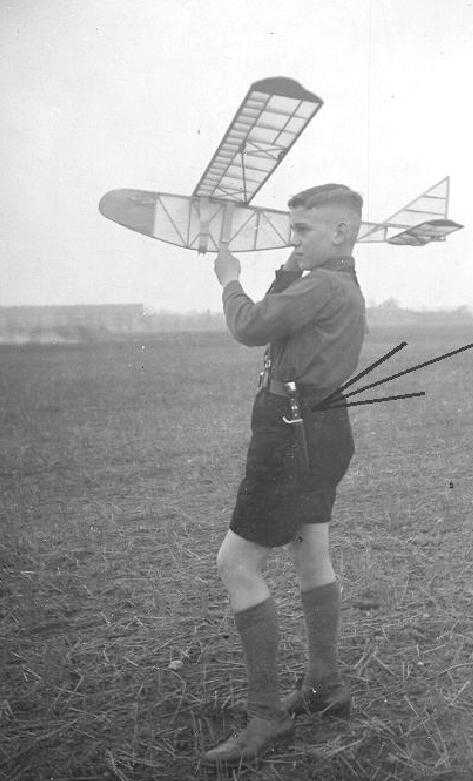
The Germans during World War I created an air arm during World War I (1914-18). The airplane was first used in any significant way in World war I. It played a useful, but marginal ole. The Allies were able to outproduce the Germans, but both side made important technological strides. The German air ace the Red Baron (von Rictoff) was the most famous pilot of the War. When he was killed, Herman Goering took over command of the the Flying Circus. The German air forces were dissolved after the War, as required by the Treaty of Versailles. Even so the German military continued to develop technology through secret arrangements with the foreign countries. German companies built planes in other countries, especially the Netherlands. Glider clubs throughout Germany provided training for future pilots. The operations were expanded when the NAZIs seized control (1933). Soviets and Japanese. Adolt Hiter ordered Göring to formally establish thevLuftwaffe (February 26, 1935). The Versailles Treatu was still in force.
The Red Army was founded by Leon Trotsky and emerged victorious in the Civil War that followed the Revolution (1917). It provided the victory when enabled the creation of the Soviet state and rulling Cimmunist Party. That Party under the command of Stalin turned on the Red Army in a series of purges launched in 1937. Here the NAZIs appeared to have played a role in inspiring the purges. As a result of the purges the Red Army was severely weakened. None-the-less under Zukov they defeated the Japanese in an undeclared border war with Japan (1939). The Red Army also along with the Wehrmacht occupied Poland (1939), fought a war with Finland (1939-40), occupied the Baltic republics (1940), and seized areas of Romania (1940). The central event in the history of the Red Army was of course the Great Patriotic War. Hitler ordered the invasion of the Soviet Union--Operation Barbarossa (June 1941). The resulting military campaign was the most titantic military struggle in human history. The Red Army weakened by Stalin's purges and inept leadership was staggered by the German blitzkrieg, but with the help of the Autumn rains and then the Winter freeze, the Wehrmachy was stopped before Leningrad and Moscow (December 1941). The German battle plan was based on lightening strikes before the opponent could adequately prepare for war. Failure first against Britain (1940) and then the Soviet Union (1941) meant that the Germans were faced with a long war of attrition and with the entry of America into the War, an alliance with superior resources. In the end it was the Red Army that stopped the Wehrmachtt and blead it to the point that the Western Allies could cross the Channel and attack the Wehrmacht from the west. After the War, the Red Army was the instrument by which the Soviet Union established a Russian empire throughout Eastern Europe--compliant satellite regimes creating Soviet style totalitarian regimes.
The Japanese Imperial Navy (Nihon Kaigun) by 1941 was the dominant naval force in the Pacific. The Japanese had a large well-trained naby with excellent ships. There was no peace-time neglect as the British and U.S. navies experienced. The American Navy was aware that the Japanese had a modern effective navy, but did not fully understand the campabilities of the Imperal Navy or the danger posed by the sizeable carrier fleet. The Japanese Imperial fleet was superbly trained with outstanding night fighting capabilities. Not only was the fleet well trained and included modern vessels, many of the Japanese vessels and naval aircraft were supperior to American and British vessels in many aspects. Japan led the world in operational aircraft carriers and carrier aircraft. (The British in 1941 were still using Swordfish biplanes on their carriers and American planes, especially the fighters were slower and less manuerable. The Japanese Mitsubishi Type 00 fighter, the Zero, was both faster and more maneuverable than either the U.S. Navy carrier fighter, the Grumman F4F Wildcat. The full extent of the threat was in part obscured by American rascial sterotypes and wide-spread belief that the Imperial Navy was not an effective force. In reterospect, the only suprising question about the attack on Pear Harbor and Japanese offensive in the South Pscifiuc, is not how they succedded, but how America managed to stop the Japanese after only 6 months of victories. The two glaring weakeneses were the lack of radar and the ineffective fore supression systems. Not well understood is that Japan had a very substantial submarine fleet.
The Imperial Japanese Army (IJA--大日本帝國陸軍) was the ground-based armed force of the Empire of Japan (1868 - 1945). The IJN was founded with the Meiji Resti\oration and the defeat of the Shogunate. As such it was the dominant militart force in Japam as th Imperial Navy was much smaller. The Imperial Japanese Army General Staff Office and the Ministry of the Army oversaw the IJA. Both were subordinate to the Emperor as supreme commander. This was the case with the Emperor Meiji. But given the rise of militarism after World War I, it was not the case of Emperor Hirohito. Given the tendency of elements within the IJA to assainate political figures which opposed them, it is unclear to what extent Hirohito had even nominal control over his military. Even after the two atomic bombs were dropped on the Japan, IJN units attempted a coup when the Emperor announced his surrender decision. During World War II a third service was organized, overseen by the Inspectorate General of Aviation.
In event of war, an Imperial General Headquarters (IGHQ) was created. During World War II it consisted of the chief and vice chief of the Army General Staff, the Minister of the Army, the chief and vice chief of the Naval General Staff, the Inspector General of Aviation, and the Inspector General of Military Training. Japanese commanders were infused with the spirit of Bushido--"the way of warriors". It is the collective term for the many codes of honour and ideals adopted by the samurais which dominated Japanese warfare for centuries. Centarl to Bushido was loyalty unto death meaning no surrender even when defeat loomed. Japan was the only industrialized country in Asia, which meant it could defeat China a much larger country, the First Sino -Japamese War (1894-95). And they defeated Tsarist Russia in the Russo-Japanese War (1904-05). And Japanese victories in World War I gave IJN commanders confidence that they had the capability to defeat major military powers. While its victories were largely based on its industrial development, IJN commanders convinced thensleves that it was the Bushido spirit that could gain victories against even the world's major industrail powers. The Soviet Red Army victory in Manchuria (July 1939), just before World War I should have convinced them that this was not the case, but it did not. The result was the disaterous Pacific War. No country instilled such fierce fighting spirit in their fighting men, but there was an extrodinary level of incompetence among Japannese officers who prepared to make frontal cahrges against entrnched forces backed by artillery and machine guns.
After the first 6 months of the WAr, the IJN did not win a single battle with the Americans, even in the rare occassions that they had superior forces such as Guadalcanal.
Military forces are designed to project a country's power. Ironically, some powerful military forces can ultimately prove to actually reduce a country's security. The best example here is Kaiser Wilhelm's highseas fleet. Germany in the mid-19th century was seen by Britain as an ally and France as a security threat. The British royal family was of German origins. Prince Albert himself was German. This view was altered by Kaiser Wilhelm II's aggressive foreign policy and boisterous, eratic behavior. This revised view was confirmed by the Kaiser's decession to build a highseas fleet. The major impact of the fleet was to seek alliances with Russia and France, Germany's historic enenies. The Kaiser's surface fleet played a very minor role in the War. The U-boat became Germany's primary naval weapon, yet the primary achievement of the U-boat fleet was to draw America into the War, thus ensuring Germany's defeat. The Kregsmarine again played a minor role in World War II. The German surface fleet was a major disappointment to Hitler. The U-boat proved again to be Germany's primary naval threat.
The Continental Army in the Revolutionary War was the first truly national institution abd of course won independence from the Brirish Empire. The United States Army has played a major role in shaping our modern world. The Grand Army of the Republic held America together in the Civil War which meant that a united American was a major influence on the 20th century. The American Army played major roles in both World wars. American entered both wars without a large trained army and in both instances Germany made a fatefull gamble that they could win the war before the arrival of the Americans in force. When America declared war on Germany (April 1917) there was essentially no American Army. Although America only entered World war I in 1917, German Field Marshal Ludendorf was to say that it was the American infantry that was the decisive force in the West. Again when World war II broke out, the American Army consisted of only a small professional core. Devisive debates were held in the Congress over drafting a sizeable force (1940 and 1941). Only amonth before Pearl Harbor, the Congress almost ended the draft and allow those drafted to return home (November 1941). A journalist working in Britain recalls see the first boatload of American infantry arriving in Britaion (January 1942). They were an Iowa National Guard unit, the 43th infantry. They landed in Belfast still wearing the old World War I helmets. They were singing, ":Ioway--Ioway--Out Where the Tall Corn Grows". The journalist writes, "I hoped with all my heart that the men who led them knew what they were doing. They seemed a little dewy behinf the ears, almost surprised that they were overseas so far from Iowa where they might soon have to fight an ememy who wanted to kill them," [MacVane, p.75.] Few in this and subsequent units had any military experience. And they would soon be pitted against the battle hardened Wehrmact arguaably the most professional military in the history of warfare. They were in fact not prepared as the Panzers demonstrated at Kaserine (February 1943). They proved, however, to be fast learners and were backed by the emenese industrial capacity of the United states. Unlike World War I, the U.s. Army did not play the central role in deating NAZI Germany. It did play an important role in defeating the NAZIs and in preventing Western Europe from falling under the orbit of the Soviet Union.
Although Americans invented the airplane (1903). The U.S. Army Air Corps was not a major factor in World War I and even had to use British and French planes (1917-18). Despite work in the 1930s, when the United States was propelled into World War II by the Japanese carrier attack on Pearl Harbor, air chiefs and air crews were shocked to find its fighters were badly outclassed by its Axis adeversaries and its bombers unable to carry out its missions without fighter protection. The same was true of the Navy air arm in the Pacific. The American naval victory at Midway (June 1942) brought time in the Pacific. Than during the following the rapidly expanding U.S. Air Forces and Navy began receiving high performance aircraft that decisively change the ballance in the air, giving the United States command of the air that it has never lost despite the best efforts of the Germans and Soviet Union. The decisive turning point in Europe was the appearance of the P-51 Mustang, an Anglo-American creation. Axis leaders launched the War believing that they could destroy cities and their own cities were untouchable. Hitler warned foreign journalists tourng the ruinS of Warsaw (October 1939), "I can do the same to any European city." And he attempted to do just that to London (1940). The Japanese did the same in China. U.S. Air Forces by the end of the War, however, had turned Axis cities, including Berlin and Tokyo, into vast heaps of rubble and charred wastelands. The key to America;s success as been the country's vibrant free market which created companies like Boeing, Grumann, Lockeed, North American and many more which created aircraft of unparalled performance and provided the indusrial capacity to produce them in numbers. The U.S. Air Force has also played a key role in the Cold War beginning with Berlin Airlift (1948-49) and preventing a North Korean victory in Korea (1950). The U.S. Air Force then providedpart of the nuclear shield as well as the tactical dominance helping to discourage a Soviet invasin of Western Europe. Today Ameican cruise missles and dromes are playing a ket role in the War against Islamic terror.
While the above forces have played major roles in history, there are of course many other military forces in history. One of these is the Russian Navy. Russia over time has been primarily a land power, but the Russian Navy has existed since Tsar Peter the Great foubded St. Ptersburg and a navy as part of his opening to the West. The Tsarist Navy's principal effort was in the Russo-Japanese War (1904-05) and ended in a disatrous defeat. The Russian Navy's primary part in history was the role in played in the Russian Revolution (1917). The Russian Navy was not a major factor in World war II. The Germans tuned the Baltic into a German lake and botteled up most of the Soviet fleet. After the War, the Soviets began building a blue-water fleet which in the Cold War became a major concern to the U.S. Navy.
Special forces existed before World Wr II, but they came into prominance during the War, in part because the phenomenal success of the Germans at the onset of the War left the British with few ways of hitting back. Small-scale commando raids and support for Resistance were at first some of the few ways the British could strike at the Germans, both strongly supported by Churchill. And onece organized, these forces were also used to support Allied offensive operations that were possible as Allied strength grew. The British SAS is often seen as the most gthroughly trained and successful unit not only during World war II, but after the war as well. The SAS first destinguished itself with daring desert raids against German airfields. [Mortimer] As is often the case, the full impact of these units is more the resources their opponents are forced to divert to counter messaures.
We intend to create a page linking pages under progress on the military forces of individual countries. At this time we only have completed a page on German World War II military forces.
We have developed pages for the military forces active during several specipic wars. This of course will focus on their operatios specifically during the War.
Colonial protests that Britain proved incapable of handling morphed into a najor war forcing Britain to deply the largest expeditionary force in history until the two World Wars of the 20th century. Several different countries and their military forces would be drawn into the War. The major combatants were the American colonies and Britain. Native Americans also became involved, most but not all chosing to support the British. Critical to the Americn cause would be European allies, especially the French, but Spain also participated in the War. The Americans began the War with poorly trained and supplied colonil militias. Vital to the success of the revolution was Washington's efforts from the mommnt he arrived in Boston (July 1775) to build a well-trained Continental Army that could toe-to-toe with the British regulars. In addition to the militia and Continental Army the Americans also had a small navy consisting of privateers. Not commonly reported was the very substantial merchant fleet the colonies had. Some of these ships were turned into privateers. Few could fight it out with Royal Navy ships, but they sucessfully disrupted Brirish commerce. The core of the British force was the British Regular Army, but other forces would support the British effort. When fighting broke out in Massachusetts (April 1775), some 5,000-10,000 British soldiers were in the the 13 colonies, Canada, and the West Indies. Over the course of the War, the British would increase their commitment more than five fold and eventually lose two field armies. In addution to professional career soldiers, new recruits would be added. Adding to the British forces were American loyalists, German mercenries, run-away slaves, and Native Americans. The major British assett in addition to the Red Coat regulars was the Royal Navy. Ironically it would be the Royal Navy's failure in the Battle of the Capes (September 1781) that would lead to the American victory. The French played a major role in the American victory at first finncing the American effort and providing supplies. Eventually France would commit army and naval forces. Spain also committed its army and navy seizing Florida from the British, helping to secure supply lines to the Americans. Native Americans were also involved. Most tribes sided with the Brirish because of British eeorts to hild the Smerivsns to the Eastern Seaboard, but some tribes sided with the Americans.
The great bulk of the Federal and Confederate armies were composed of regiments raised in the states. They were then assigned by the Federal and Confederate Governments to the major military formations. The two most important military formations in the Civil War were the Federal Army of the Potomac and the Confederate Army of Northern Virginia. Most of the most famous battles of the War were fought by these two formations. The Army of Northern Virginia was commanded for most of its history by Gen. Robert E. Lee. At the hear of the AONV was Jackson's Corps which heped beginning at First Bull run gain one victory after another. This included Lee's most stunning victory at Chancellorsville, but failed at Gettysburg under a new commander. The Army of the Potomac (AOTP) had a series of commanders as President Lincoln struggled to find a competent commander. Gen. George McClellan played a major role in building the AOTP, but he was reluctant to use it. Lincoln once quiped, "If McClellan isn't going to use the Army, perhaps he will lend it to me. Civil War armies were composed of corps, usually 2-4 divisions or 10,000-30,000 men. At the heart of the AOFP was the famed Second Corps in which 40,000 of the 100,000 men who served were killed. [Kreiser] There were also Federal and Confederate formations in the West. There Federal armies under Granht and Sherman largely destroyed the Confederate formations during the first three years of the War. Small units operated in the West.
Europe at the eve of World War I was an armed camp. All the European powers except for Britain had conscriptions systems and large armies. And the majoe powes were making massive expenditures to equip those armies. Even small countries had substantial armies. Germany had the strongest and best organized army. It also had the most efficent reserve force and organization to rapidly mobilize reserve forces through an efficent railway system. Germany had the industrial power to equip its army, although its industial capacity was not as great as that of Britain and France combined. The German Army was committed to a war of movement and gaining early victories by concentrating forces at critical points. Germany was also building a navy to challenge the long dominant British Royal Navy. Russia had the largest army, but it was ponderous and tool time to mobilize. It lacked the industrial power to prperly equip its army. The French Army was also sizeable and fortified with the manpower of its colonies which contributed nearly 0.5 million men, narrowing the German manpower advantage. The British at the onset of the War had only a small, but highly professional army. The British Expeditionary Force (BEF) would play a key role in slowing the German offensive through Belgium. Eventually the British had to turn to conspription. The Royal Navy was Britain's principal force in beding and with the French Navy was able to effectively blockade the Central Powers. The British Empire forces (Australia, Canada, New Zealand, and South Africa) were also important. The small Belgian Army was quickly mobilized and played an important role in slowing the German offensive in the first month of the War. The Austro-Hungarian Army was substantial, but proved much less effective than the German Army. They were unable to defeat the Serbs until refinforced by the Germabns and Bulgarians. The Serb Army managed to escape encirclement and was evacuated by Allied naval forces. The Ottoman Army was substantial, but the country did not have the industrial capacity to build modern arms. The Germans supplied some modern equipment. The United States which would play a played a decisive role in the war, had a very small army which it did not begin to increase significantly until declaring war (April 1917).
Each of the major beligerants at the outbreak of World war II had substantial military forces. hey were almost all located in Europe. Jaoan was the one outlyer. China had a large army, but poorly equipped and trained. The one exception was the Unite States which had such a small army and arms industry that it was largely dismissed by the Axis leaders. Ironicall, the United states was the only country with the manpower and economic (industrial and agricultural) to wage global warfare. As in precious wars there were armies and navies. World War II had a third force, air forces, whiich played a major role in the War. These had begun to evolve as separare forces, although the american air force was still organizationlly prt of the U.S. Army. Air warfare had begun in World War I, but no where near the importance and scope or the power of World War II. There was considerable similarity in the organization of the military forces built up by the important belgerants. There were also important differences. The U.S. Marine Corps (naval infantry) played a key role in the Pacific War, in part because the scale of many island battles was a fraction of the important European battles. And the Waffen-SS, a highy politically motivated force, became an imoprtant part of the German armed fores and German military action in the final 2 years of the War. Several of the beligerants set up commando forces with different names. In the Axis countries, the police/security forces assumed important military or para-military roles. The same was the case in the Soviet Union, often commiting unimaginable war crimes. Only in Japan, however, did the military actually take control of the government and in essencey played the role of a Fascist political party. At the onset of the War the focus was on weapons, especially planes and tanks. It was not yet understood that the real advantage that the German Wehrmacht held was they had litterally invented modern warfare--Blitzkrieg. World War I began as a war of movement, but after the Miracle on the Marne became a war of attrition. A war of attrition as in World war I ould be disaster for Germany. The Blitzkrieg doctrine broke the Western front wide open and gave the Germans areal chance of winning the war. What Hitler misjudgd was the will of the British to reist, the strength of the soviet union, and the war making capacity of the United States. Germany needed quik victories to win the war. It would only be so long before the undefeated enemies he created would understand an adopt their own Blitzkrieg doctrine.
James, Simon. Rome and the Sword (2011).
MacVane, John. On the Air in World War II (William Morrow and Company: New York, 1979), 384p.
Mortimer, Gavin. The SS in World War II: An Illustrated History (2011), 256p.

Navigate the Children in History Website:
[Return to Main war and conflict essay page]
[Introduction]
[Biographies]
[Chronology]
[Climatology]
[Clothing]
[Disease and Health]
[Economics]
[Geography]
[History]
[Human Nature]
[Law]
[Nationalism]
[Presidents]
[Religion]
[Royalty]
[Science]
[Social Class]
[Royalty]
[Bibliographies]
[Contributions]
[FAQs]
[Glossaries]
[Images]
[Links]
[Registration]
[Tools]
[Children in History Home]