|
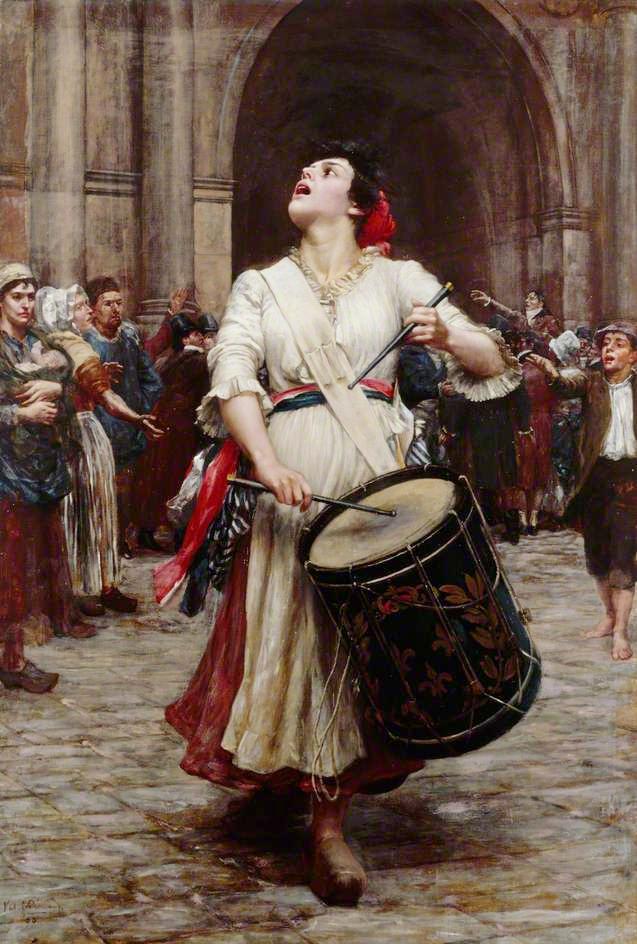
The French Revolution was a dramatic break with Europe's feudal past. As such it is the most important event
in modern European history. The rise of the bourgeoisie in France signaled the death knell for Ancien Regime, the
old aristocracy. Unlike Britain and the new United States, the economically important bourgeoisie was denied any
political role and support of the increasingly frivolous aristocracy imposed a great economic cost on France. Not
only was the bourgeoisie denied any real political role, but the lower classes lived in increasingly deprived
conditions, a situation intensified by the bankruptcy of the royal government. The increasing opposition to
France's virtually feudal government suddenly ignited during a 1789 riot that exploded into open revolt. The
Revolution was opposed by the other counties of Europe--all monarchies. A new Republic toppled the monarchy. A
series of sporadically violent and radical civilian administrations ruled France. The height of violence was
reached in the "The Great Terror." King Louis XVI and Queen Marie Antoinette to the horror of Europe were
guillotined. The execution of the King and Queen made any accomodation with the Republic impossible. Foreign armies converged on Paris again, but were defeated by Republican forces under the new tri-color flag. Eventually a
remarkably capable and charismatic general seized control of the Revolutionary armies and the Republic merged into
the new French Empire. The disorders and violence in France were to engulf all Europe in war, first with the new
French Republic and then with Napoleon's Empire. The resulting wars and campaigns were the most significant in
Europe until World War I (1914-18). The French Revolution had profound political, social, and economic
impacts. The dress of aristocracy came into question. Powdered wigs disappeared very quickly. Knee breeches
endured longer as they were also worn by the bourgeoisie. The working class had already begun wearing long
trousers. It was boys from well to do families that first began wearing long pants as part of a dress
costume--usually a skeleton suit. We are not sure why boys were the first to adapt this style.
The rise of the bourgeoisie in France signaled the death knell for Ancien Régime, the monarchy and the old aristocracy. Unlike Britain and especialy the new United States fostered by France, the economically important bourgeoisie was denied any political role in France. There was no parliament as in Britain nor constitution, written or unwritten. Louis XVI had inherited a centralized, absolutist state largely fashioned by his great grandfather, Louis XIV--The Sun King. Louis XIV was famous fir his statement, "I am the state." This absolutist state was continued by Louis XV, but Louis XVI had inherited a bankrupt state because of financial mismangement, afevated by Britain and support for of all things the American Revolution. France was potentially the richesv country in Eurpe, but maintenance of the increasingly frivolous and costly aristocracy imposed a great economic burden on France. Not only was the bourgeoisie denied any real political role, but the lower classes lived in increasingly deprived conditions, a situation intensified by the bankruptcy of the royal government. The term Ancien Régime appeared only after the begiining of the Reviolutiion when the paticipans suddenly realized the extent of their nreal with the past. The Rebolutionaries differed on what the term meant. Some believed it was a break from all of Frebncgh history, at least from the country's medieval era. Oters were thinking about the more recent pre-revolutionary past.
After all it was only Louis XIV that had creatred an absolutist state (17th century). The Revolutionaries in the ground-breaking Constitution of 1791 abolished the hereditary nobility, venality of office, the medieval guilds, monasticm, and a wide range of privileges. These of course were monumental steps, but many Revolutinaruies wanted to and did go far further aiming at the monarchy itself.
The Enlightenment along with the Renaissance and Reformation was a key step in the formation of the Western
mind. Many of the most influential Enlightenment thinkers were French, but the Enlightenment was a movement which
over time affected all of Europe to varying degrees. America was also affected by the Enlightenment, but the
American experience was different, in part because of the Great Awakening. The Enlightenment is also termed the Age
of Reason. Authors define it differently and there were many different aspects, but the Enlightenment at it heart
was a basic turn in the Western mindset. The West for more than a millennium had been dominated by religion, often
described as faith. Even the Reformation had not changed this. In fact the Protestants were often more consumed
with faith and theological questions than the Roman church. With the Enlightenment, primacy was given to reason.
Intellectuals began to think that objective truth about life and the universe could be achieved through rational
thought. The advances achieved in physics, led by Sir Issac Newton in Britain, had a profound impact on European
intellectuals. Enlightenment writers began to think that the same kind of systematic thinking could be used to
understand and improve areas of human activity as well. A whole new system of aesthetics, ethics, government, and
logic was developed based on reason. The Enlightenment was an era of great optimism. Enlightenment thinks were
convinced that reason could dramatically improve society. They were not openly atheistic, but they were highly
critical of religion which they often equated with irrationality and superstition. The Enlightenment also attacked
political tyranny. The intellectual ferment of the Enlightenment led to the American and subsequent Latin American
revolutions as well as the French Revolution which had a much more pronounced impact on Europe. the Enlightenment
prepared the foundation for both classical liberalism and capitalism. There were comparable movements in music
(high baroque and classical) and art (neo-classical).
Louis succeeded to the throne on May 10, 1774 after his grandfather's, Louis XV, death. Louis died an
unpopular king. His grandson Louis XIV was still young and had great trepidation about reigning. At the time, he
was still immature, lacking in self-confidence, and because of a physical defect (later remedied by an operation)
frigid in his relations with his young wife. His wife was Marie Antoinette, a very young Austrian Arch-Duchess
(princess). The French Bourbons and Austrian Hapsburg were the two most prestigious royal houses in Europe. The
marriage represented a new alliance between these major European powers which had for years been fighting each
other. which Although well-disposed toward his subjects and interested in foreign policy, Louis had not
sufficient strength of character or power of decision to combat the court factions or give support to reforming
ministers. His poor education made him susceptible to the intrigues of scheming advisers. Louis did not have the
strength of character or foresight to pursue needed reforms when possible or to deal with the Revolution when it
occurred. His undoing of the judicial reforms of his grandfather cost him prestige, and his reign was marked by the
increasing strength of the aristocrats, who opposed most economic and administrative reforms.
Historians debate the causes of the revolution. Most agree as to the forces that led to the Revolution, but
disagree as to the relative importance. The years leading up to Revolution was an era pf political, economic, and
political turmoil. The finances of France were shattered by the ruinous Seven Years War in which France under Louis XV fought both Prussia and
Britain. As a result of the war France lost both India and Canada and was left with only a few Caribbean islands
as an overseas empire. France the once dominant European power is humbled. Partially as a result, the new king
Louis XVI decided to aid the American colonists against Britain. French support is critical for the success of the
American Revolution it also proves disastrous for the French monarchy. The loans and
cost of the war bankrupted the royal government. The French population grew substantially during the 18th century,
but French law and the economic system kept wealth and property essentially in the hands of the nobility. Some
authors stress the oppressive character of the royal government as a factor. Economic conditions seem to have been
even more important. Poverty grew and the bankruptcy of the monarchy aggravated the situation. Another factor
was the rising economic importance of the bourgeoisie and their desire for political power. Another important
factor was the Enlightenment which had raised dangerous new ideas about liberty and equality. The Enlightenment
called into question the underlying principle of the feudal system that still dominated Europe that hierarchy an
inherited social status was the natural state of affairs endorsed by God through the Church. Had the economy been
stronger and had the peasantry and urban poor not been experiencing such economic privations the debates of the
Enlightenment might have remained in the salons of Paris. The increasing poverty of the people led many to question the validity of the monarchy, especially an absolute monarchy. Many came to see the absolute monarchy as
absolutely responsible for the situation in France.
France experienced another poor harvest (1788). Bread prices began to rise. The poor in France essentially
lived on bread. The poor already living on the edge or pushed toward starvation. The Winter of 1788-89 was one of
the worst on record creating even more misery. Thus public discontent grew fed by rumors of the royal court
extravagance, especially the Queen's suposed excesses. Louis tinkered wwith fiscal reforms, but as the clergy and aristocracy did not pay taxes this meant higher taxes on the already burdened people. Food shortages occurred. Disorders occur in Paris and other cities. There are riots with mobs breaking into bakeries and other stores.
King Louis XVI faced with insurmountable financial difficulties, especially the massive and growing debt, appointed Jacques Necker finance minister. It was popular choice as Necker had written on the need for reform. Even
Necker, however, was able to resolve the problem of the crushing deficit. Facing bankruptcy of the Royal Treasury, bankers insisted that Louis summon the Estates General, a body that could approve new taxes. French kings had not convened the Estates General for 175 years. Louis finally complied and summoned the Estates General. It proved a disaterous mistake. Louis and his ministers very quickly lost control. After 6 weeks of deadlock and radical demands by the Third Estate, Luis decided to close the whole effort. The Third Estate, however, defied the King and after being shut out, adjourned to of all places the royal tennis Court wherev they took a fateful oath -- the Tennis Court Oath. This turned the Estates Generalm into the National Assembly. At the same time, the restive people of Paris began to organize, effectively launching the Revolution. Rumors began to circulate in Paris that Louis was moving troops to suppress the National Assembly and bring order to Paris. He reportedly was concentrating 30,000 troops around the city. The people of Paris to defend themselves established a Parisian city government--the Commune. And perhaps more importantly, they formed a National Guard. The need for gunpowder briught them to the Bastille, here the attackn on the Bastill became the date from which the Revolution is dated (July 14).
The King When the Revolution broke out, allowed himself to be controlled by reactionary court factions into
defending the privileges of the nobles and clergy, and continued to believe that the Revolution would burn itself
out. Unfortunately for Louis, it only grew in strength. The Revolutionaries began to fear
the King and his family would attempt to escape Paris. Louis tried to leave the Tuileries for Saint-Cloud (Easter
1791). He wanted avail himself of a conjuring priest (1791). He was unable to do so.
The émigrés reached the conclusion that without the nobility dominated officer corps that the Revolution did not
have a creditable army. Representatives of the surrounding countries (Austria, Switzerland, Sardinia, and Spain)
met at Mantua (May 20, 1791). They secretly committed to invading France and restoring King Louis to power. king
Louis rejected the plan. Instead he supported General Bouillé, who condemned both the emigrees and the Assembly.
He promised the King refuge and support in his camp at Montmedy. The King with his family fled the Tuileries
(June 20, 1791). A carriage took them on the road to Chålons in an effort to reach Montmedy. When his absence was
noted, the Assembly acted decisively. They seized executive power and obtaining oaths from loyal troops. King
Louis refused to disguise himself and was recognized and arrested at Varennes l (June 21). He and the royal family
was escorted back to Paris under close guard. Pétion, Latour-Maubourg, and Barnave, representing the Assembly met the disheartened royal family and escort at Epernay. Barnave became a counselor and supporter of the royal family. Upon entering Paris, the crowd was generally silent. The Assembly provisionally suspended the King Louis as reining monarch. They placed him and Queen Marie Antoinette under guard. Despite attempts at compromise Louis was accused of treason and tried.
The monarchies of Europe rallied to the defense of the King and Queen. A combined Austrian-Prussian-army
accompanied by Royalist forces invaded France and moved toward Paris with the intention of freeing the King and
Queen an suppressing the Revolutionaries. The Austrians were especially concerned because Queen Marie Antoinette
was an Austrian princess. Revolutionary authorities cobbled together a force of regular army troops that had
declared loyalty to the Republic and revolutionary volunteers. To the surprise of most of Europe, the new French
army emerged victorious at Valmy (August 1792). The French artillery was especially effective. The French gained
another victory over the Austrians at the Battle of Jemappes (November 1792) in the Netherlands.
The defeat of the Austrian-Prussian armies strengthened the hands of King's enemies, essentially sealing his fate. Valmy was particularly important. Louis was officially arrested (August 13, 1792). The royal family was held at the Temple, a medieval fortress in Paris that was used as a prison. The National Assembly declared France to be a Republic and abolished the Monarchy (September 21). The Assembly stripped Louis of all of all of his titles and honors. He now became known as simply Citoyen Louis Capet. The Girondins, the dominant Jacobian political faction wanted to hold the now deposed king decurely in the Temple under arrest to use as a hostage and a bargaiing chip with the Republic's enenies. Members of the Commune and the growing number of more radical deputies wanted the King executed. The more radical faction was forming as the Mountain. Many of the deputies, both the Girondins and Mountain, had legal backgrounds. Thus there was general agreement that there needed to be a legal process--a trial and not a summary exection. The Delegates decided that Louis be tried before the National Convention -- essentially by the French people. The Assembly saw it as the institution composed of the representatives of the sovereign people. Some historians se the King's trial as actually a trial of the revolution itself. And the trial was seen as such at the time. The death f the King essentally met the life of the Revolution. An innocent verdict was never possible, the only question was if the king would be executed. And the King's position was undercut by armoire de fer (iron safe) incident tht at occurred at the now vacated Tuileries Palace. François Gamain, the Versailles locksmith, went to Paris and informed the Jean-Marie Roland, Girondinist Minister of the Interior about a hidden safe in the King's bedroom (November 20). When opened, the King's safe was found to hold compromising documents and correspondence. When made public, the King was fuly discredited. Three weeks later, the King was separated from his family. He was brought from the Temple through crowded and silent streets to stand before the Convention (Decenber 11). He was incicted for high treason and crimes against the State. A day fter Christmas, Louis' chief counsel, Raymond de Sèze, delivered his response to the charges. The Revolutionary government ordered the execution of King Louis and Marie-Antoinette (January 1793). King Louis XVI was guillotined (January 21) and Queen Marie Antoinette followed him a few months later. The execution of the King and Queen made any accomodation with the Republic impossible. Other monarchs felt that the continued existence of the French Republic endangered their thrones, viewing it as a deadly contagion. The execution of the King in particular transformed the British and their powerful fleet into a foe committed to overturning the regicides.
The French Revolution rather than the moderate American Revolution set the pattern for revolutionary movements. The Revolution soon spun out of control. The Revolution abandoned its motto Liberté, Egalité, and Fraternité and great Declaration on the Rights of Man. Achievements like press freedom were suspended. Led by Robespierre, the Revolution descended into terror--the Reign of Terror. As would prove to be the case in the great revolutions of the 20th century, the Revolution after dispatching the nobility and other royalists turned on its own. Robespierre not only was lopping off the heads of aristocrats, but began to target his political rivals among the revolutionaries--even within the Jacobin Club. The moderate girondists and soon anyone could be grist for the guillotine. Fellow revolutionaries like Danton went to the guillotine. The Constitution of 1791 was to be the permanent constitution for a new France. Instead France has had 11 different constitutions, two monarchies, two empires, and five republics. Much of this instability can be traced to Robespierre and the Reign of Terror. The great tragedy is that future Revolutions would make the blood letting of the Reign of Terror look inconsequential. The Terror ended only when Robespierre made a serious error. He announced to the Assembly that he had the names of more traitors (July 26, 1794). He did not, however read the list, but said he would announce them the following day. Had he not delayed the announcement, he probably would have remained in control. But left a day to react, none of the delegates could be sure that they were not on his list. In self defense they organized a kind of coup against him. Joseph Fouché who had blood on his hands as well, organized Robespierre's overthrow. (Fouché would become Napoleon's major policeman.) As a result, when Robespierre returned the next day, he and his major supporters were arrested before he could read his new list. The following day he and his cloes colleagues attempted suicide. Robespierre shot himself, shattering his jaw, but survived. His execution finally brought the terror to a conclusion (July 28).
New foreign armies invaded France and achieved some successes. The Republic declares a national levee en mass,
significantly expanding the army. The French commanders are able to first stop the foreign armies. The French
then over 2 years drive the Austrians what is now Belgium and then The United Provinces (Northern Holland).
Failing to achieve any success, many countries (Hanover, Prussia, Saxony, and Spain) withdrew from the coalition.
Only Austria and Britain by 1795, continued fighting against Revolutionary France. Austria, unlike Britain, had
no Channel separating them from the French. Austria now was fighting the French on the continent alone. The
conflict ebbed and flowed. Archduke Charles held the French generals Joubert and Moreau at bay in Germany.
Disaster befell the Austrian forces in Italy. A young general, skilled in the use of artillery, Napoleon
Bonaparte, forced the Austrians out of northern Italy in a brilliant campaign of devastating speed. Napoleon's Army of Italy in only a years gained control over the Po River Valley. He then moved north, joined with Joubert's
forces and moved on Vienna. The Austrian's were forced to ask for peace terms. The Austrian capitulation left
Britain alone
Paris from the earliest point in the French nation has played a major role Beginning with the fall of Bastille, Paris was the primary stage for the unfolding Revolution. Many view the Revolution as a Parisian phenomenon, playing out at the Bastille, Versailles, the Tuileries, the chambers of the Jacobin Club, and the Place de la Concorde. Paris became notorius for the Terror and the guillotine. TheTerror was, however, not restricted to Paris. There were outbreaks of terror throughout the provinces. [Ballard] There was also support for the monarchy in the provinces. The most serious was the War in the Vendée (1793-96). The Vendée is a coastal region south of Brittany bordered by the Loire River in west central France. Conditions in the Vendée were not as favorable to the Revolution as in Paris and many other regions of France. Class differences were not as pronounced. The Vendée was a relatively isolated province. The nobility was highly residential and seems to have maintained relatively good relations with the peasantry. There was also a strong devotion to the Catholic Church. Problems began with the Civil Constitution of the Clergy (1790). Agents informed the Convention of the disturbing opposition to the Revolution in the Vendée (1791). The Marquis de la Rouerie organized a royalist plot. The breaking point was the National Convention's decision to expand the army with a levy of 300,000 men (February 1793). The Vendée erupted. One of the martial myths of the Revolution came out of the fighting in the Vendée--Joseph Barra. The Jacobins described his attackers as 'brigands', but they were presumably peasants defending the church and monarchy. Another royalist revolt was the Chouannerie. It occurred in 12 of the western départements of France, particularly in the provinces of Brittany and Maine. It wssimilar to the Vende, but north rather than south of the Vendee. At times the headquarters was in London. The Chouannerie was fought out primarily during the Directory and was no ended until Napoleon seized power (spring of 1794 until 1800). There were three destinct phases. Tthe Association bretonne attempted to defend the monarchy and reinstate the laws and customs of Brittany that the Republic had repealed (1789). The Chouannerie began in force like the Vendee revolt with the Civil Constitution of the Clergy and the levée en masse decided by the National Convention. The first disturbances occured (1792) and evolved to a peasant revolt like the medieval Jacquerie. Than guerrilla warfare began which evolved into actual large-scale battles. Finally the Republican/Imperial forces previled (1800). More localized peasant uprisings occurred in other départements (Aveyron and Lozère) which were also called 'chouanneries', but were much smaller.
The sans-culottes were the common people of France meaning the lower classes. Many had become radicalized and fervent supporters of the Revolution. In particular Paris mobs became the driving force of the Revolution. It was the Paris mobs that brought the royal family from Versailles to Paris. And the sans-cullotes, both the urban working classes and peasantry made up the great mass of the Revolutionary Army, at first poorly armed and euipped but with revolutionry ardor.
Their support was derived from their poverty and life experiences under the Ancien Régime. The term 'sans-cullotes' means without short pants, but at the time referred to the fashionable silk and satin knee breeches worn by men of means, both the nobility and and bourgeoisie. The working class had begun in the 18th century to wear pantalons or long trousers often cuffed and done in wool. As the highly centralized French state was based in Paris, the city's sans-cullotes often described as the Paris mob played a major role in the development of the Revolution, driving radicalism.
The Directory was the next to last stage of the French Revolution. It would be a failed experimentment in constitutional government sandwiched between two dictatorships. It followed the Committe of Public Safety with its Terror. The Directory was the collective leadership of five directors which constituted the executive. There was a bicameral legislature known as the Corps Législatif. The lower house was known as the Conseil de Cinq-Cents (Council of Five Hundred) as there were 500 delegates. They had to be 30 years of age or over. Their duty was to propose legislation. The upper house or Conseil des Anciens (Council of Ancients) was made up of 250 delegates. They had to be 40 years of age or over. They considered the legislative proposals of the lower house. And could approve or disapprove the the proposed legisltion. The Ancients or upperhouse also selected the five Directors (Directeurs). They chose from lists prepasred by the lower house. A Director had to be at least 40 years old. The idea was to have experienced men, thus a Director had go have served as a deputy or minister. A new director was chosen every year, thus the Directirate was theoretically a rotating execurive with each director serving 5 years until being replasced. The Directors appointed the major government ministers, ambassadors, army generals, tax collectors, as well as and other officials. The centralized powers of the former Committee of Public Safety theoretically were assumed by the Directorate. A fatal weakness was finance which had led to Louis' demise. The Firectorate did not have the funds needed to finance the Government. Nor were courts created to enforce its laws. The basic weakness was, however, its weak executive powers. It was designed to avoid the puritanical dictatorship of the Commottee of Punlic Safety and Reign of Terror. The Directory was ended by the Bonapartist coup of 18 Brumaire (November 1799) and the creation of the Consulate. This was the beginning of the more disciplined Napoleonic ductatorship. Most historians date the end of the Revolution to Napoleon's rise as First Consul.
It is the wars and domestic violence, especially The Terror, which is most often associated with the French Revolution. The Revolution was in fact an era of enormous social change, which is reflected in the changing fashions of the day. One major development was the changing role of women in social life. Upper and middle class women until the French Revolution were largely secluded at home. This was less true for poor women who were forced to work, both inside and outside the home. It became common for women, at least in Western Europe, to join in squares and promenades to socialize and show off their latest frocks and bonnets. Unmarried younger women would of course be strictly supervised. Women also began to form joint benevolent societies for a variety of charitable purposes. Influential courtesans in France before the Revolution hosted salons where men and women could gather to discuss ideas, listen to music, and socialize. After the Revolution, such gatherings became much more common for both the upper and middle class.
The French Revolution is best known for the Regin of Terror and many wars, but it had profound economic consequences. The Revolutionaries abolished many of the constraints on the economy that had been erected over time by the Ancien Régime. These restions began with the medieval guilds and continued by the decrees issued by sucessive momarchs pursuing mercantilist policies. Much of this was swept away by the Revolution. The guild system was abolished as a worthless remnant of medieval feudalism. The Revolutionaries also did away with the inefficient and harmful system of tax farming which meant that private individuals would collect taxes for of course a substantial fee, increasing the buden on productive enterprises. The Revolutionaries seized the revenue stram for hospitals, poor relief, and education, but did not continue funding so most of the country's charitable and educational systems were disrupted. The economy plummeted with the disruptions in public life (1790-96). Both industrial and agricultural output plummted as well as foreign trade. Prices as a result of inflation soared. The Revolutionaries from an early point decided not to repudiate the debts of the Ancien Régime. Instead their approcah was to print vast amounts of paper currency -- the Aassignat. This was backed by the lands sized from the arististocracy which was being guillotined. The result was to fuel inflation. The Revolutiinary Government resonded by imposing price controls. The police were ordered to arrest speculators merchants selling in black market. People resisted paying taxes. The government deficit spiraled out of control. It was 10 percent of gross domestic product (GDP) (1789), but raeched 64 percent (1793). After the poor harvest of 1794 and the removal of price controls, inflation becgan to reach Zimbabewan/Venezuelan 3,500 percent (1795). The Government cancelled the assignats (1796), but the taxes which repaced it caused furher inflation. The rampid inflation was finally ended by Napoleon with the creation of a new cirrency--the Franc (1803). The inflation had mamy adverse consequences, but it did have the impact of rendering the debts of the Ancien Régime meaningless. Agriculture more than any other sector was transformed by the Revolution--primarily because it trmasformed ownership of the land. Many of the most important nobels owning vast estates lost their heads and estates. The Revolutionary Government abolished tithes owed to the Churc which was amajor landoner. They also abolished the feudal dues owed to the great nobel landlords. The result at first hurt the tenant farmers who paid both higher rents and higher taxes, but left the tennants in possession of the land they would eventually own. The Revolutionary Government nationalized all church lands as well as lands belonging to royalist enemies who went into exile--saving their heads if not their land. The initial plan was to use the income from the seized lands to finance the government by through assignats. The breakup of the large estates owned by the Church and the nobility and worked by hired hands and tenant farmers tansformed rural France where most of the population lived. Rural France became a land of small independent farmers. There was no place like it except America. The rural proletariat was transformed in to small commercial farmer. This mean that the revolutinary minded rural peantry was transforned into the most conservativce sector of society -- the rural and now land-owning peasantry. One important Engish expert on French historian writes succintly that the Revolution 'bequeathed to the nation a ruling class of landowners.' [Cobban] Despite the political instability and infation, small scale entrepreneurship flourished in the cities as all the restrictive monopolies, privileges, barriers, rules, taxes and guilds of the Ancien Régime were removed. The Royal Navy blockade, however, damaged overseas trade. And the Haitian Revolution weakened French finances. The income from Caribbean sugar plantations had been enormous. The Revolution did not, however, fundamentally change the country's French business system. It basically froze French industry in place. The French businesses sector was primarily small shop owners or operators of local mulls with family help and a small number of wage emolotees. Large industrail concerns were less common than in France than in other industrializing countries. This would have little impact on the Wars of tf the French Revolution and Napoleon, but would significantly affect France's place in Europe in the 19th century.
The new American Republic was a minor actor in the late 18th century. The American reaction to the French Revolution was of little consequence at the time, but it is interesting. The United States was at the time the only Republic of any consequence All other important countries were monarchies. As France, albeit the monarchy, played a critical role in the Revolution, it would seem that America would have been a strong ally of the Revolution. And indeed there were partisans of France and the Revolution in America, especially at the beginning of the Revolution. This was, however, surprisingly limited, especially given the intensity of anti-English feeling in the country. President Washington wisely saw the need for America to stay out of European wars. Perhaps more importantly, while anti-English feeling was rampant, America had largely retained English values and law. More than anything it was the turn toward violence that frightened many Americans. This was especially rue in the South which found the focus on equality especially dangerous. The XYZ Affair caused enormous resentment in America.
African slavery became well established in European colonies, including French colonies, during the 17th
century. African slavery was an important economic institution by the 18th century, especially important for the
Caribbean sugar islands which were a major element in Western European economies. France lost most of its empire
to the British, but retained important Caribbean islands. Liberty was a byword of the French Revolution as it had
been in the American Revolution. But like the Americans, the leaders of the French Revolution did not move toward
abolition. In America any step toward abolition during the Revolution or the framing of the Constitution would
have meant disunion as it would have been unacceptable to the southern colonies. In France it appears to reflect
the bourgeoise character of the Revolution and the economic importance of Caribbean slavery to the French economy.
While France did not move toward abolition, the Revolution did have substantial reverberations, both in the
Caribbean and in England which affected slavery.
A fascinating footnote of modern history is that perhaps the greatest French leader of all time, Napoleon Bonaparte, as a boy did not speak French and grew up hating France. He was sent by his father, who has decided to
collaborate with the French invaders, to study in a French military school. Napoleon never really forgave his
father for collaborating with the French. It was in these schools, however, where he was dismissed as a foreign
nobody that Napoleon virtually slowly became French--although he was unaware of it at the time. He emerged as one of the major generals of the Diectory. He eturned from his Egyptian ecapade a hero, arriving before news of the disaster. He moved to end the Directory. His coup of 18 Brumaire creating the French Consiulte and brining Napoleon to power as First Consul of France--the other two consuls had only advisory roles. Most historians date the end of the Revolution to 18 Brumaire in the French Republican calendar (November 9).
It is difficult to decide just when the wars of the French Republic become the Napoleonic Wars. We believe that
the victory over the Austrians is probably the best point. In the next major French campaign, Napoleon although
not yet Emperor has become the dominate force in France. The Napoleonic Wars extended over nearly 20 years and
included a number of distinct campaigns. The important campaign of the Napoleonic Wars are Egypt (1798-1801),
Second Coalition (1798-1801), Third Coalition (1805), Fourth Coalition (1806-07), Fifth Coalition (1809), the Peninsular War, (1808-14), Invasion of Russia (1812), Germany (1813), Invasion of France (1814), and the 100 days campaign (1815). British actions against American shipping resulted in a war with the fledgling United States, referred to as the War of 1812 in America.
I am not entirely sure what the modern French view is of the Revolution. Surely this depends in part on the
political philosophy of each individual. A French reader writes, "French schools teach that the Revolution brought
great social progress. Just what that progress was is a matter of conjecture. The constitution was built on the
precepts " Liberté, Egalité, Fraternité ". These three words are today written everywhere. Hopefully other French
readers will tell us what they were taught in school. France of course has assisted American in its Revolutionary
War, despite the fact that the country was at the time a monarchy. There was great sympathy in America at first for the Revolution, but as it descended into violence and terror, America turned away in horror. Today Historians
still debate many aspects of the Revolution. The Revolution was of course Europe's first major break with monarchy and first attempt to govern a major country as a republic. The results send shivers through much of Europe for decades. Perhaps the most enduring question flowing from the Revolution was whether Napoleon was the end or continuation of the Revolution.
Ballard, Ruchard. The Unseen Terror: The French Revolution in the Provinces.

Navigate the Children in History Website:
[Return to Main French history page]
[Return to Main war page]
[Return to Main Revolution page]
[About Us]
[Introduction]
[Biographies]
[Chronology]
[Climatology]
[Clothing]
[Disease and Health]
[Economics]
[Freedom]
[Geography]
[History]
[Human Nature]
[Law]
[Nationalism]
[Presidents]
[Religion]
[Royalty]
[Science]
[Social Class]
[Bibliographies]
[Contributions]
[FAQs]
[Glossaries]
[Images]
[Links]
[Registration]
[Tools]
[Children in History Home]