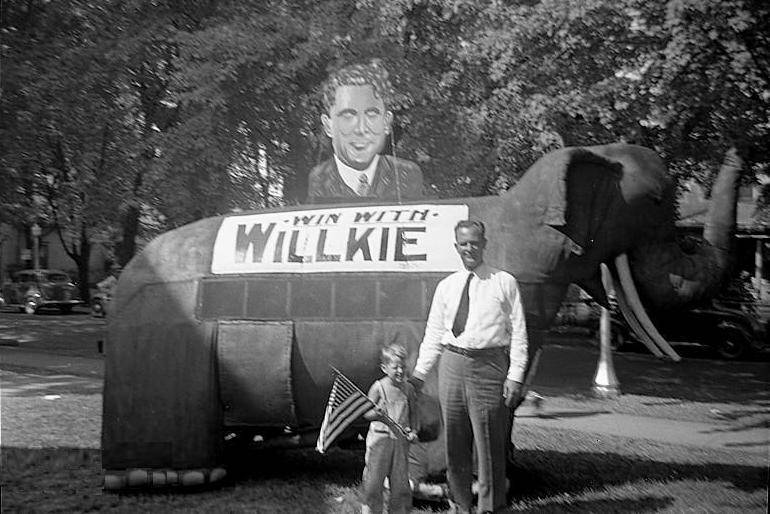
Figure 1.-- The Republican Party was the stronghold of the Isolationists. Several Republican senators were outspoken critics of President Roosevelt's efforts to contain the NAZIs. Hitler gambeled that the Isolationists would prevent America from intervening until he had compkleted the conquest of Europe. The NAZI conquest of France (June 1940) shocked many Americans. The first actual political impact was the Republican Convention's decesion to nominate Wendel Wilkie. He was an internationalist with basically the same international outlook as President Roosevelt. His domination dashed Hitler's hopes that an Isolationist might be elected president.
The 1940 presidential election is arguably the most important election in American history. The first American President, George Washington, retired after two 4-year terms. This set a precedent that every other president had followed. FDR because of the international crisis decided to run for a third term which became a campaign issue. The national debate over neutrality and isolationism that had been raging since the mid-1930s reached its height. There were powerful spokesmen on both sides. Isolationist groups, such as the American Fist Committee, opposed any risks that could lead to war and shaply attacked the President's policies. International groups and an increasing number of average citizens demanded more active aid to Britain. His Republican opponent was a surprise choice, Wendell Willkie, a wealty busniessman who had swept the Republican primaries. Willkie did not crticise FDR's support for the democracies, by the time of the camapign only England. His nomination was an indication of the shift in public opinion toward intervention. Willkie instead pledged "all aid to the Democracies short of war". He attacked the New Deal on domestic issues, what he referred to as the socialistic policies of the Administration. Roosevelt's foreign policy was, however, an issue in the campaign. The isolationists led by the American First Committee accused FDR of trying to drag America into the war. Speaking in Boston on October 30, the President assured his audinence, "I have said this before, but I shall say it again, and again and again: Your boys are not going to be sent into any foreign wars." Usually the phrase was "foreign wars" and usually the President added, "unless we are attacked". The election was another victory for FDR, but not the landslide of previous camapigns. Still FDR carried 39 of the 48 states. The election, however, was much closer than suggested by the results. FDR saw his re-election as strong pupblic support for a program of military preparedness and aid to Britain.
Importance
The 1940 presidential election is arguably the most important election in American history. The election of 1860 was also a critical election, but in 1940 no less than the future of western civilization was at stake. Hitler had succeeded in conquering most of central and Western Europe. This includes France which had been the bulwark against the Germans in World War I. Many qestioned Britain's ability to hold out. And if Britain fell, with it would go the Royal Navy and America would have no capability to bring its power to bear against the NAZIs. Most Americans saw Hitler as evil, but the full barbarity of the NAZIs was not yet understood. Europe's future would be either the NAZIs or Soviets--a chilling prospect. Primemiminister Churchill put it best. "What General Weygand called the Battle of France is over. I expect that the Battle of Britain is about to begin. Upon this battle depends the survival of Christian civilization. Upon it depends our own British life, and the long continuity of our institutions and our Empire. The whole fury and might of the enemy must very soon be turned on us. Hitler knows that he will have to break us in this island or lose the war. If we can stand up to him, all Europe may be free and the life of the world may move forward into broad, sunlit uplands. But if we fail, then the whole world, including the United States, including all that we have known and cared for, will sink into the abyss of a new Dark Age made more sinister, and perhaps more protracted, by the lights of perverted science. Let us therefore brace ourselves to our duties and so bear ourselves that, if the British Empire and its Commonwealth last for a thousand years, men will still say, �This was their finest hour.�� Britain might be able to survive, but without American assistance, vwould never be able to renter the Continent. This mean that Europe would be dominated by either Hitler or the NAZIs. One historian describes the resulting stakes. "The Humanism of Westrn civilization and the essence iof Christian morality, the peerles legacy of the Enligtenment and Thomas Jefferson's immortal affirmation of the inalienable human rughts of life, liberty and the pursuit of hapiness all stood on the brink of annihilation." [Dunn] One might see such statements as histrionics, but as Americans went oeacefully to the polls, Hitler and his accolytes had set in motion barbaric programs of uninmaginable evil, including the Hunger Plan and Generalplan Ost a blueprint for killing of which the Holocaust was only one part and far from the largest part.
Two Term Tradition
The Constitution placed no limit on the number of terms a preident could serve. Many precedents were set by the first American President, George Washington. He retired after two 4-year terms. This set a precedent that every other president had followed. It had become by the 20th century a rock solid defacto law of Americann politics. President Theodore Roosevelt refused to run fior a third term, even though his first term had resulted friom President McKinnley's assasination. Had it not been for the War, the Roosevelt's would have retired quietly to Hyde Park. Mrs. Roosevelt was preparing for this and looking forward ton it. The issue was particularly touchy for President Roosevelt as tghe Reoublicans including President Hoover had been charging that he was absusung power and trying to undermine the American democratic system. Here the President's illadvised court packing attempt had given them fodder. There were many Americans, although a minority, who hated Roosevelt and the New Deal, along with his opinionated wife and even his 'little dog' Fala. They assumed that because of the two term traditiion theu would finally see the last of him. Roosevelt as the consumate politican understood that a third term would be difficult. And as a result we do not kniw why he decided to run again. Perhaps he enjoyed the job too much. Probably he believed that he was uniquiely situated to deal with the war crisis, which actually was true. His sollution was that to show no personal interest in a third term. He talked longongly of returning home to Hydev Park to the press. Meanwhile he ordered his aides to organize a 'draft Roosevelt' effort within the Democratic Party. [Dunn]
President Roosevelt presided over one of the most productive period of reform in American historty. He did not end the Depression. Somde modern economists criticize his ecconomic policies. But he did adopt policies wjhich helped many mericans cope with the Depression. Is aid to unions helped lay the foundation for a vibrant economy after the War. Other ptograms like the Social Security, bank and security reforms, the Civilian Construction Corps, the Tennssee Valley Authority, Rural Electrification, and the Works Progress Administration, profoundly shape a more inclisive and just American system. Just when the President decided to run for a third is not known. At the beginning of the year he appears to have begun planning for life after the presidency. He signed a contract to write editorials. Elenor in prticular was looking forward to leaving the White House. He spoke with his cabintet officers about their presidential prospects. He seems to have favored Secretary of State Cordell Hull. Postmaster General Jim Farley seems to have thought he had good prospects. The President does not seem to have even confided with Elenor. The President was probably undecided for some time. The German successes in the West (April-June 1940) must have decided the issue for him. Until just before the Democratic Convention, there was no word frpm the President on his intentions. A week before the Convention, the President indicated to Party leaders that because of the critical international situation, he would accept the Democratic nomination. Some of the President's inimtes were suprised when he decided to run for the third term.
The isolation movement in America was still very strong, The national debate over neutrality and isolationism that had been raging since the mid-1930s reached its height during the 1940 election. The isolationists persisted after the election, but the 1940 election was their best chance of defeating the President and reshaping American foreign policy. There were powerful spokesmen on both sides. The Isolationists were wellm organized and vocal, including respected politicans, business leaders, and the press. The swing area in Anmeruican opolitics was the Midwest and there large numbers of voters failed to see the danger and were determined to stay out of 'Europe's War'. Isolationist groups, such as the American Fist Committee, opposed any risks that could lead to war and shaply attacked the President's policies. International groups and an increasing number of average citizens demanded more active aid to Britain. When the year began, the merican public were still strongly isolationist. After the NAZI victories in the West, first Denmark and Norway (April); then the Netherlands, Luxenboutg, and Belgium (May); and finally France (June)--American public opinion began to significantly shift. Americans were not prepared to enter the War yet, but measures to strengthen national defense and aid Britain that the isolaionists had opposed were now being viewed much more favorably.
The NAZIs victory in the West fundamentally changed the world ballance of power. The isolationists were still a poweful force in America after the fall of France. But the debacle began to change public opinion. Important elements of the Republican Party were strongly isolationist. Willkie in an act of considerable political courage broke with the isolantionists and condemned Hitler. He also supported the draft (conscription) bill which despite the fall of France was still very controversial.
Republican Convention: Philadelphia (June 24 to 28, 1940)
Most notable Republicans were isolatioinists, especially the Congressional wing of the Party. Given the Republican gains in 1938, it is likely that the Reublicans would have won in 1940 had President Rooselvely not decided to run for relection. And until the Convention met, it looked like they would nominate a isolatiinist. Most political observers thought that the Republicans would nominate either staunchly isolaionist Senator Robert Taft (Ohio) or Disrtrict Attorney Thomas E Dewey (New York). Taft was the rising Republican star in the Senate. Dewey made a name for himself fighting crime in New York. There was also dark horse Senator Arthur Vandenberg. They were all isolationists, especially Taft and Vanenberg who were outspoken about their objections to President Roosevelt's sympathy with the Allies. Corporate attorney Wendel Wilkie was an even darker dark horse. Wilkie was not an isolantist which made his nomination even more unlikely.
Few believed that the Republicans would nominate an internationalist. The Convention was held, however, only days after the fall of France which had shocked most Americans. American public opinion as a result was shiting, NAZI successes in Europe had begun to show how misguided the isolations were. The Republican delegates in Philadelphia were as shocked as other Americans. There was only one notable Republican that had internationalist views. The Luce papers had been promoting a utility executive that was virtually unknown at the beginning of the year--Wendel Wilkie. He had entered and swept the Republican primaries. (Only a few states at the times had primaries, however, so Dewey had the most delegates. ) Wilkie unlike the other major candidates, upported the President's efforts to aid Britain. When the balloting began, Dewey led for the first three ballots, but he could not achieve a majority. The galleries at the Convention strongly favored Wilkie and erupted in chants, "We want Wilkie." Wilkie took the lead on the forth ballot, but Taft was still very close to him. Finally on the sixth ballot, Wilkie won. The President when he learned of Wilkie's nomination commented, "That's good news for the country, but may be tough for me." [Peters] He was right. Wilkie was the only one of the four Republicans that he ran against that was a real threat. But more importantly it was the definitive turning point in his fight with the Isolationists. The President could move ahead with aiding Britain and because of Wilkie, the isoltionists in Congress could not make a major issue of it. The immediate result was the "Bases for Destroyers" deal.
British Security Coordination--BSC (June 1940)
The story of how America developed a secret operations service is nothing short of shocking. Amazingly it began with the British who set up a covert operation to sway American public opinion and disrupt Axis operations in the the United States. It was arguably the most succeessful covert operation of the War. British Intelligence (MI6) ran the operation from their Passport Control Office in New York City. This innocuous sounding office was a cover the British used for the operations of the Secret Intelligence Service (MI6) around the world. This office was greatly expanded when a Canadian, William Stephenson, was personally placed in charge (June 1940). Stephenson had been a pilot in World War I and after being captured by the Germans escaped from a POW camp. He was a talented boxer and struck up a frienship with Gene Tunney during the inter-War era. He dabeled in radio, designing radio set just as radio was making it big and made a personal fortune. He also got involved in steel and made another fortune. As a business man he traveled in Germany and reported back to the SIS (MI6). This is how he got the New York assignment. He named his group British Security Coordination, only because he needed an officia and inocuous name when he registered with the FBI. His orders were to carry out "all that was not being done and could not be done by overt means to ensure sufficient aid for Britain and eventually bring America into the war." Tunney introduced Stephenson to Federal Bureau of Investigation, Bureau Director J. Edgar Hoover. He told Hoover that he wanted to work with the FBI. Hoover replied that the President would need to approve this. President Roosevelt did not hesitate.
German Covert Activities
Dr. Hans Thomsen was the Charg� d'Affaires at the Embassy of Germany in Washington. The United States after Kristallnachr recalled its ambassador in Berlin (November 1938). The German Government then recalled Ambassador Hans-Heinrich Dieckhoff. Thomsen
appears to have accurately assessed the Roosevelt Administration and its anti-NAZI orientation. Like Ambassador Dieckhoff reported to Berlin on the President's hostility. While he was in charge of the Embassy, the Isolationist Movement in America gained strength. He did what he could to support the Isolationists. He did what he could to support Americans opposing involvement in another world war. [Thomsett, p. 151.] Thomsen saw an opportunity in the 1940 presidential election to replace Roosevelt with an isolationist Republican. He thus oversaw an effort at the Republican National Convention to pass an anti-war platform. [Stout] Thomsen cabeled the Foreign Ministry that a "well-known Republican congressman" had offered to take a group of 50 isolationists to the convention $3,000. (June 12, 1940). [Wallace, p. 262.] He was apparently reffering to arch FDR-foe Hamiltion Fish. There is no collaboration that Fish actually solicited such a bribe. Thomsen asked Berlin for the requested funds as well as the money to arrange for full page advertisements in newspapers during the convention. The source of the funds of course was hidden. The ads were placed. They were written by George Viereck, a German agent working for Congressman Fish.
The ads appear to have had some affect. Thomsen reported back to Berlin that the wording of the Republican Plank "was taken almost verbatim" from an ad which appeared in the New York Times as well as other papers. No one really knows, but there is no evidence indicating that Fish was involved with the German campaign. He certainly was an importahnt isolationist and opposed in American particiption in another war. He directed the National Committee to Keep America Out of Foreign Wars, the group which sponsored the ads. Of course all this came to naught when the Republicans nominated Wendel Wilkie who shared Rossevelt's dislike of the NAZis.
Democratic Convention: Chicago (July 15-18, 1940)
There were no surprises at the Democraric Convention about who they were going to nominate for president. Once it was known that the President would accept the nomination, the Democrats did not need much urging. There was no desire to change horses in the middle of the river, either among Democrats or Americans in general. President Roosevelt deftly orcestrated the Democrats in Chicago to draft him for renomination. Politically he could not be seen as wanting a precedent-shatering third term. He thus had his political operatives stage a draft Rossevelt movement at the Chicago Convention. A 'spontaneous' demonstration occurred in favor of the President's nomination. The Democrats crossed the Rubuicon and broke the two-term tradition. The vote was a firegione conclussion. They nominated The President for a thitd term on the first ballot. Some said, "Better a third term than a third rater." There was no other Democrat that had near the appeal of the President. There was, however, considerable resistance to Roosevelt's choice of vice president, the liberal Secretary of Agriculture Henry Wallace. Wallace was one of the keading New Dealers. Agricukture had been an important part of New Deal effirts, including social experimentation. Some delegates may have resisted the Wallace nomination to protest Roosevelt's manipulation of the Convention, but there was also oposition to Wallace's liberal views. There was the beginning of a revolt, but Elenor rushed to the convention and helped convince the delegates that the President should have the running mate of his choice.
Wendel Wilkie
The President's Republican opponent was a surprise choice. Wilkie grew up in humble circumstance in small town Indiana. Many Americans saw him as cut in the Will Rogers mold. His rumpeled suits stood in sharp contrast to that of the always emaculately dressed Tom Dewey. And he had a friendly smile, a valuable political assett. He was conservative, but not as conservative as Senator Robert Taft which would have made his election problematic. Wilkie was a captain during World War I. Wilkie as late as 1924 had been a Democrat and had even supported the League of Nation. He also fought against the Klan--a poweful force in Indiana during the 1920s. He had made a name for himself by opposing the Tennessee Valley Authority (TVA). TVA was a regional development project based in part on government power production. It was one of the most notable New Deal agencies. Wilkie's criticism of the New Deal was more reasoned than many Republicans who after two drubbings by the President had developed a pathological hatred of Roosevelt, Elenor, and the New Deal. He actually favored several important New Deal programs. TVA of course was not one of them. Willkie was a wealty busniessman who had swept the Republican primaries. Wilkie proved to be a charismatic campigner and his down to earth approach resonated with many Americans. Willkie did not crticise FDR's support for the democracies, by the time of the camapign only England. He criticized details, but not the principal commitment to aid Britain. He was an internationalists who insisted that America had a vital interest "in the continuation in the wirkld of the Englisgh, French and Niorwegian way of life." His nomination was an indication of the shift in public opinion toward intervention. While not an experienced politican, he had good politican instincts. One gistorian explains that he followed "... George Washington's carefully honed script. .... {He} presented himself not just as a successful businessman but as a firnmer soldier in France, a man who had nio taste for power but was willing to accept the people's call to serve." [Dunn] Unlike many Republicans, Wilkie was not going to fight the 1936 campaign and the New Dealm all over again. Rather both Roosevelt abd Wilkie agreed that gthe central issue of the campaign had been decided by Hitler--NAZI aggression.
Churchill as the Panzers poured into France pleaded with President Rossevelt for assistance. One possibility was mothballed destroyers, sorely needed to protect the critical North Atlantic convoy routes. The U.S. Navy had "moth balled" 70 destroyers after World War I. In fact FDR as Assisstanat Secretary of the Navy had played a part in this. There were great dangers to America in providing these destroyers to Britain. Not only would it be an act only slightly short of war, but it would weaken the ability of America to rapidly expand its fleet. Even more serious was that if Britain capitualed, the destroyers might even fall into German hands. The President also faced political dangers in that the Republicans could charge him with weakening America's defenses, a serious concern in the middle of the 1940 presidential election campaign. FDR finally agreed on August 14 during the height of the Battle of Britain to provide the British badly needed destroyers for their Atlantic convoys being hard pressed by the U-boats. At this stage of the War any good news was extremely important for the British and Churchill. The executive order was issued August 27, 1940. The United States would trade 50 old Navy destroyers for 99 year leases on British sea and air bases in the Western Hemisphere (most were in the Caribbean and in Newfoundland). The approach was extremely savy politically. It sounded like an actual exchange and involved bases close to the United States. In actuality the British were more than willing to provide America bases. It was also a cold political calculation. It was still unclear as to whether Britain would survive. If there was to be a British Vichy, it would be important to have American bases on the British Atlantic and Caribbean islands. The President also allowed British pilots to train in the United States and British ships to be repaired in U.S. ports. The Flight Ferry Command and Eagle Squadron were created. These were very bold exactions taken by the President without Congressional cover in the middle of the presidential election campaign.
The United States in 1940 was still largely unarmed. In particular the U.S. army except for a small professional core practically did not exist. There were still calvalry units and the force that did eist was not armed with modern weapons. The United States in 1940 despite the wars raging in Europe and Asia had an army smaller than that of several small European countries. The American army was smaller than that of Romania. At the Admistration's urging, Congress after an intensive debate, approved the first peacetime draft in American history. President Roosevelt on September 16 signed the Selective Service Act. The first draft had been during the Civil War. The draft envolved men from 21-35 years of age and involved only 1 year of training a military service. The votes in Congress were comfortable majorities as most Democrats and about half the Republicans supported it despite of the upcoming election November election. Undoubtedly the radio bradcasts and newsreel images of London burning under the NAZI Blitz were making an impression on the American people. The passage of such a controversial measure in the middle of a hotly contested presidential campaign is a marvel of presidential courage amd leadership. Here had Wilkie not supported the measure, the President might have had real difficulty securing pasage. [Peters]
War Backdrop
The 1940 election campspaign unfolded with the dramatic events of World War II , including the fall of France and the NAZI Blitz on Britain. Americans pondered theor vote while seeong London burn in the movie newsreels. President Roosevelt responding to plans from Prime Miniser Churchill increasingly desperate pleas for assistance. In another act of political courage, President Roosevelt announced plans to turn over 50 World War I destroyers and other supplies to Britain in exchange for bases in the Caribbean. Wilkie supported the deal, but criticized Roosevelt for not first obtaining Congressional approval.
The Campaign (July-October 1940)
The 1940 campaign was not what the isolationists and most Republicans had expected. The Republican party had been strongly isolationist, but Willkie broke with Party leaders. His foreign policy was essentially the same as that of the President. Both hated Hitler and advocated suppofrt for Britain. And both had to contend with the Isoltionists and their most popular spokeman, Charles Lindberg, who essentially was advocating accepting Hitler's demands. [Dunn] Even Primeminister Chamberlain had come to see the futility of appeasement, but millions of Americans still did not. Even so, Willkie pledged 'all aid to the Democracies short of war' which was essentially the President's position. He also supported the peave time draft which could have been an effective campaign issue. Wilkie attacked the President on domestic issues. He criticized the New Deal's shift toward socialism. He also questioned the President's decession to break the third term precedent. He was supported by most newspapers, which was always the case for Republican candidates during the Roosevelt years. While Wilkie and Roosevelt generally agreed on foreign policy, the isolations still entered the fray. They accused the President of attempting to drag America into the war. He nmade some gestures to the isolationists. One historian insists that he quickly regretted them. [Dunn] Overall he made it ckear that he loated thec NAZIs abnd other Fascits. Roosevelt announced a plan to turn over 50 destroyers to Britain by issuing an executive order--Bases for Destroyers (August 1940). It was a bold move, reflecting how deseperately Britain needed aid. Wilkie supported the action but attacked Roosevelt for not obtaining Congressional support for his actions. The President then annoinced a peace time draft (September 1940), another courageous action. The election of 1940 was a triuph of democracy in a world adrift with Fascist babarity. [Dunn] Wilike towards the end of the campaign escalted his attacks and charged that Roosevelt if reelected would lead America to war. By this time Wilkie had apparently closed much of the emense gap between him and Roosevelt in the polls. As is so often the case in elections, feeling that victory was actually within his grasp, began to claim that Roosevelt was dragging the United States into War. Roosevelt felt the pressure. Speaking in Boston on October 30, the President assured his audinence, "I have said this before, but I shall say it again, and again and again: Your boys are not going to be sent into any foreign wars." Usually the phrase was "foreign wars" and usually the President added, "unless we are attacked". He told aides that it was obvious.
Election Results (November 1940)
While the Luftwaffe bombers smashed away at London and the Whermact begining to redeoloy Eest, Americans peacefully went to the polls. The election was another victory for FDR, but not the landslide in the popular vote he won in his previous camapigns. Still FDR carried 39 of the 48 states. The election, however, was much closer than suggested by the results. Roosevelt won with 27 million votes, Wilkie had 22 million. While this was a substantial vote for Roosevelt, it was 5 million more votes less than the two previous Republican candidates. Wilkie's victories were primarily in the Mid-West, notably states with important German-American populations and string isolationist views. Wilkie was also string in New England. He carried 10 states. While that mnay not seem impressive, it was much better than the two previous Republican nominees did against Roosevelt. And even nore importantly, the vote in several key states such as New York was very close, within 1-3 percent. Roosevelt became the only American president to serve more than two terms. Over coming the no third term convention was a major step in American political life. Most isolationists voted against Roosevelt, despite the fact that Wilkie was no isolationist. Other Americans voted for Roosevelt, preferring a trusted leader to address arising from the war in Europe. While the campaign had become bitter. After the election, Wilkie decided to use his influence to help President Roosevelt save Britain.
Significance
President Roosevelt saw his re-election as strong public support for a program of military preparedness and aid to Great Britain. Clearly the election of Taft or Dewey would have been disastrous for America. Taft and the other isolationists had opposed the draft as well as military spending. Had they won, America essentially would have entered World war II without an army. Some have argued that Wilkie would have pursued the same policies as the President. This is perhaps true. We think he would have tried, although we are not at all sure he would have gone as far as the President. And he was far less prepared to be president than Roosevelt. [Dunn] Of course we will never know how he would have done. We do know hiw President Roosevelt did. While his effectiveness in dealing with the Depression is a matter of considerable controversy, there is virtually no disent among historians that he was a highly effective war keader. We would say that by setting the Arsenal of Democracy in motion, saving Britain and drawing Japan's attention away from the Soviet Union (and thus heloing to preventaJapan frim hoining the German assault on the Soviet Union), the President largely determined the outconme of the War before Pearl Harbor abnd fiormal entry into the War. Even so, Wilkie's importance should not be cunderstated. Wilkie and the Reoublican internatiuonalists vanwuished the Prty's isolationist wing. This plsyed a major frole in fostering a growing nationjal consensus mastermined by the President to confront the aggressor nations in both Europe and the Pavific. The United States under Rosssevelt's direction by late 1941 was engaged in an undeclared naval campign in the North Atlantic. But the greatest difference between Wilkie and Rooevelt was the Republican Party. President Roosevelt could rely on the support of most of the Congressional Democrats for his efforts to rearm and aid Britain. The leadership of the Republican Party was, however, strongly isoltionist. Thus Wilkie could not have counted on the support of his own party. Wilkie after the election visited embattled Britain and at Secretary Hull's request, returned to testify before Congress for Lend Lease. He may have well been the decisive voice in winning Congressional passage.
Personal Experperiences
The election of 1940 essentially assured Britain's survival in the face of NAZI aggression. A British reader who was evacuated to America remembers the election, but was not aware at age 10 years that the fate of his country was being determined. He tells us, "The American 1940 Presidential election was my first introduction to politics. I was just 10 years old and in my first month of 6th Grade school in America. As soon as the campaign hotted up, probably around October, there was a buzz in the playground and the boys, in particular, started sporting Roosevelt or Willkie campaign lapel badges. There were more Willkie supporters than Roosevelt, I remember, but I had no idea about the beliefs of the two parties. The family that fostered me were Republicans. They told me that the Republicans were a bit like the Conservative Party in England. That didn't mean much to me. I knew Churchill was Prime Minister, but that was about all. As a 10 years old I was not a political animal. Maybe nowadays with all the media attention given to polital campaigns it means more to today's 10 year olds." Alan has provided us a fascinating account of his and hus brother's evacuation and exploits in America Alan and Grahan.
Sources
Dunn, Susan. 1940: FDR, Wilkie, Lindbergh, Hitler--The Election Amid the Storm (Yale University Press: 2013), 418p.
Peters, Charles. Five Days in Philadelphia: The Amazing "We Want Willkie!" Convention of 1940 and How It Freed FDR to Save the Western World (2005), 256p.
Stout, David. "How Nazis tried to steer U.S. politics" New York Times (July 23, 1997).
Thomsett, Michael C. The German Opposition to Hitler: The Resistance, the Underground, and Assassination Plots, 1938-1945 (McFarland & Company: 1997).
Wallace, Max. The American Axis: Henry Ford, Charles Lindbergh, and the Rise of the Third Reich (St. Martin's Press: 2003).